Chapter 17: Signal processing
Robert Johansson
Source code listings for Numerical Python - Scientific Computing and Data Science Applications with Numpy, SciPy and Matplotlib (ISBN 979-8-8688-0412-0).
import numpy as npimport pandas as pd%matplotlib inline
import matplotlib.pyplot as pltimport seaborn as snsimport matplotlib as mpl
mpl.rcParams["mathtext.fontset"] = "stix"
mpl.rcParams["font.family"] = "serif"
mpl.rcParams["font.sans-serif"] = "stix"
# sns.set(style="whitegrid")import matplotlib as mplfrom scipy import fftpack# this also works:
# from numpy import fft as fftpackfrom scipy import signalimport scipy.io.wavfilefrom scipy import ioSpectral analysis of simulated signal
def signal_samples(t):
    """Simulated signal samples"""
    return (
        2 * np.sin(1 * 2 * np.pi * t)
        + 3 * np.sin(22 * 2 * np.pi * t)
        + 2 * np.random.randn(*np.shape(t))
)np.random.seed(0)B = 30.0f_s = 2 * B
f_s60.0delta_f = 0.01N = int(f_s / delta_f)
N6000T = N / f_s
T100.0f_s / N0.01t = np.linspace(0, T, N)f_t = signal_samples(t)fig, axes = plt.subplots(1, 2, figsize=(8, 3), sharey=True)
axes[0].plot(t, f_t)
axes[0].set_xlabel("time (s)")
axes[0].set_ylabel("signal")
axes[1].plot(t, f_t)
axes[1].set_xlim(0, 5)
axes[1].set_xlabel("time (s)")
fig.tight_layout()
fig.savefig("ch17-simulated-signal.pdf")
fig.savefig("ch17-simulated-signal.png")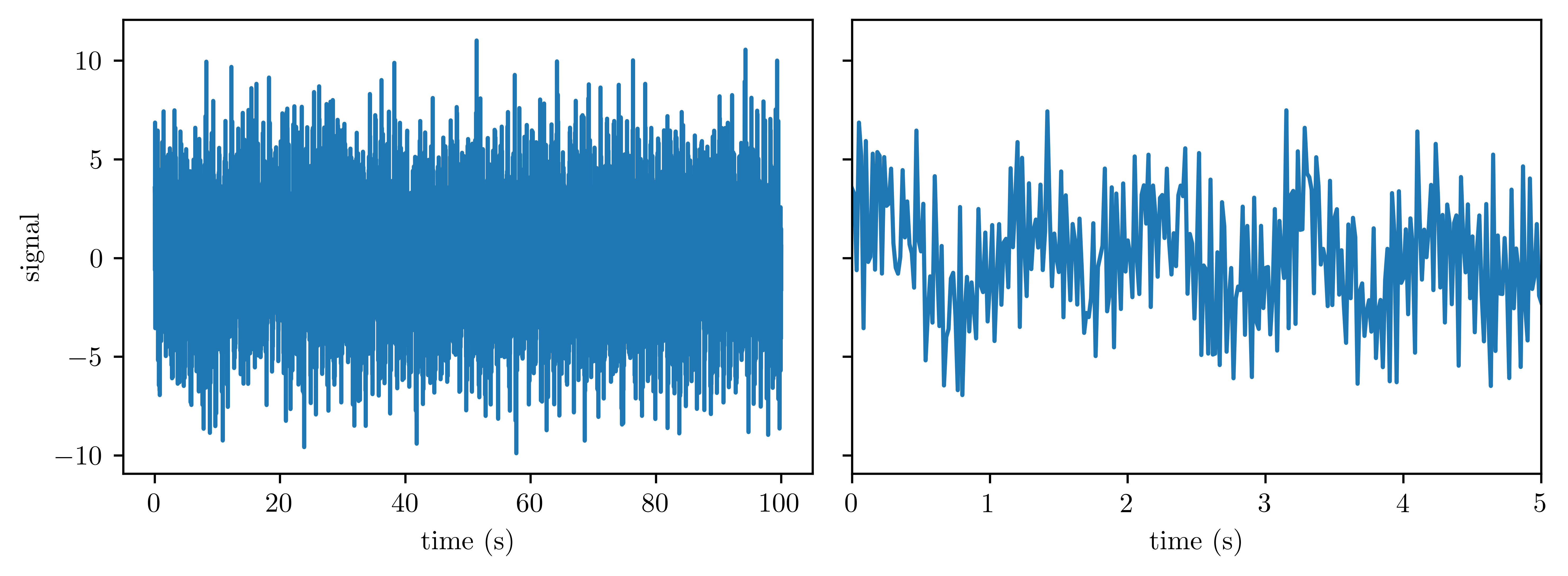
F = fftpack.fft(f_t)f = fftpack.fftfreq(N, 1 / f_s)mask = np.where(f >= 0)fig, axes = plt.subplots(3, 1, figsize=(8, 6))
axes[0].plot(f[mask], np.log(abs(F[mask])))
axes[0].plot(B, 0, "r*", markersize=10)
axes[0].set_xlim(0, 30)
axes[0].set_ylabel("$\log(|F|)$", fontsize=14)
axes[1].plot(f[mask], abs(F[mask]) / N)
axes[1].set_xlim(0, 2)
axes[1].set_ylabel("$|F|/N$", fontsize=14)
axes[2].plot(f[mask], abs(F[mask]) / N)
axes[2].set_xlim(19, 23)
axes[2].set_xlabel("frequency (Hz)", fontsize=14)
axes[2].set_ylabel("$|F|/N$", fontsize=14)
fig.tight_layout()
fig.savefig("ch17-simulated-signal-spectrum.pdf")
fig.savefig("ch17-simulated-signal-spectrum.png")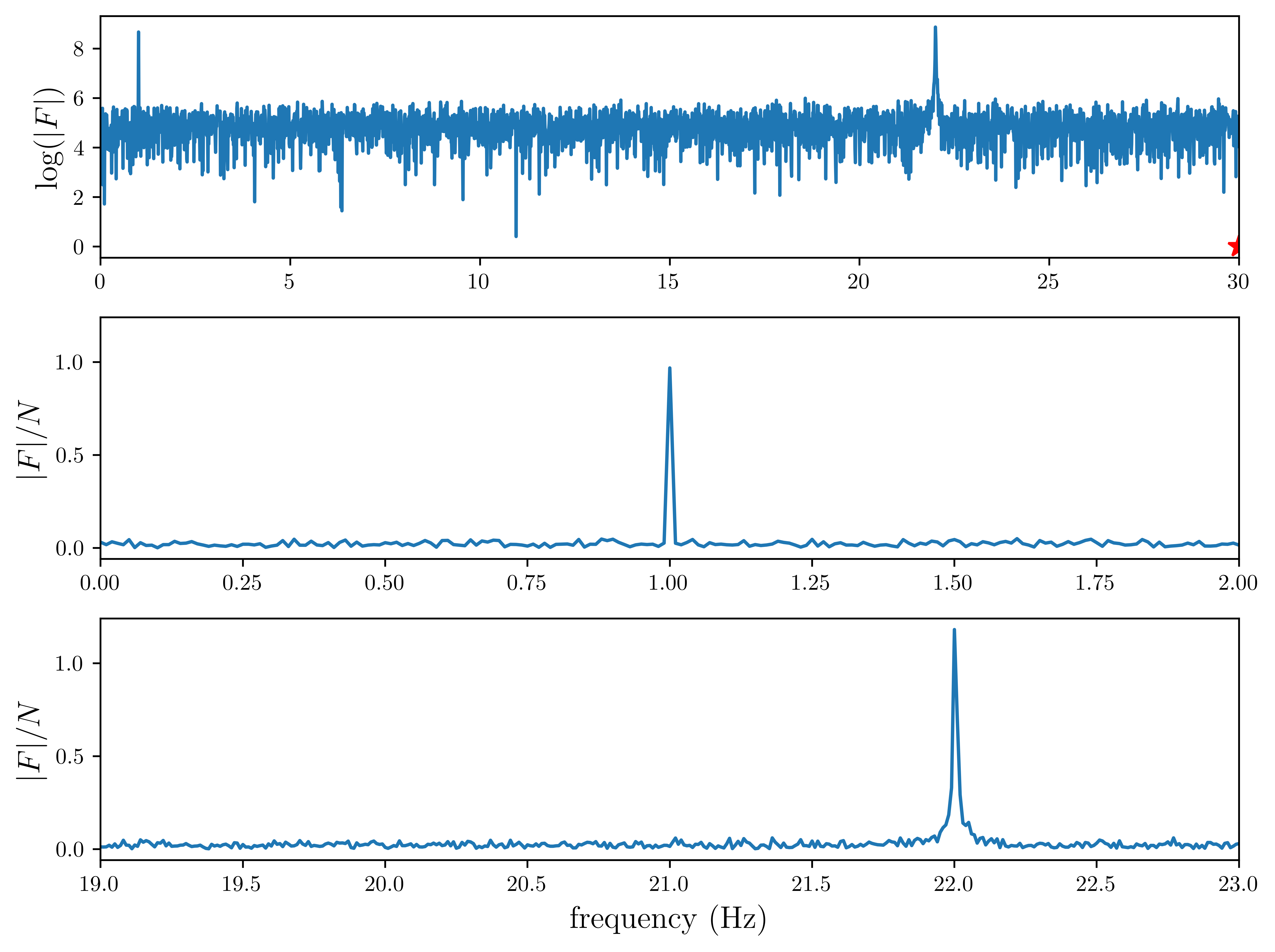
Simple example of filtering
F_filtered = F * (abs(f) <= 2)f_t_filtered = fftpack.ifft(F_filtered)fig, ax = plt.subplots(figsize=(8, 3))
ax.plot(t, f_t, label="original", alpha=0.5)
ax.plot(t, f_t_filtered.real, color="red", lw=3, label="filtered")
ax.set_xlim(0, 10)
ax.set_xlabel("time (s)")
ax.set_ylabel("signal")
ax.legend(loc=2)
fig.tight_layout()
fig.savefig("ch17-inverse-fft.pdf")
fig.savefig("ch17-inverse-fft.png")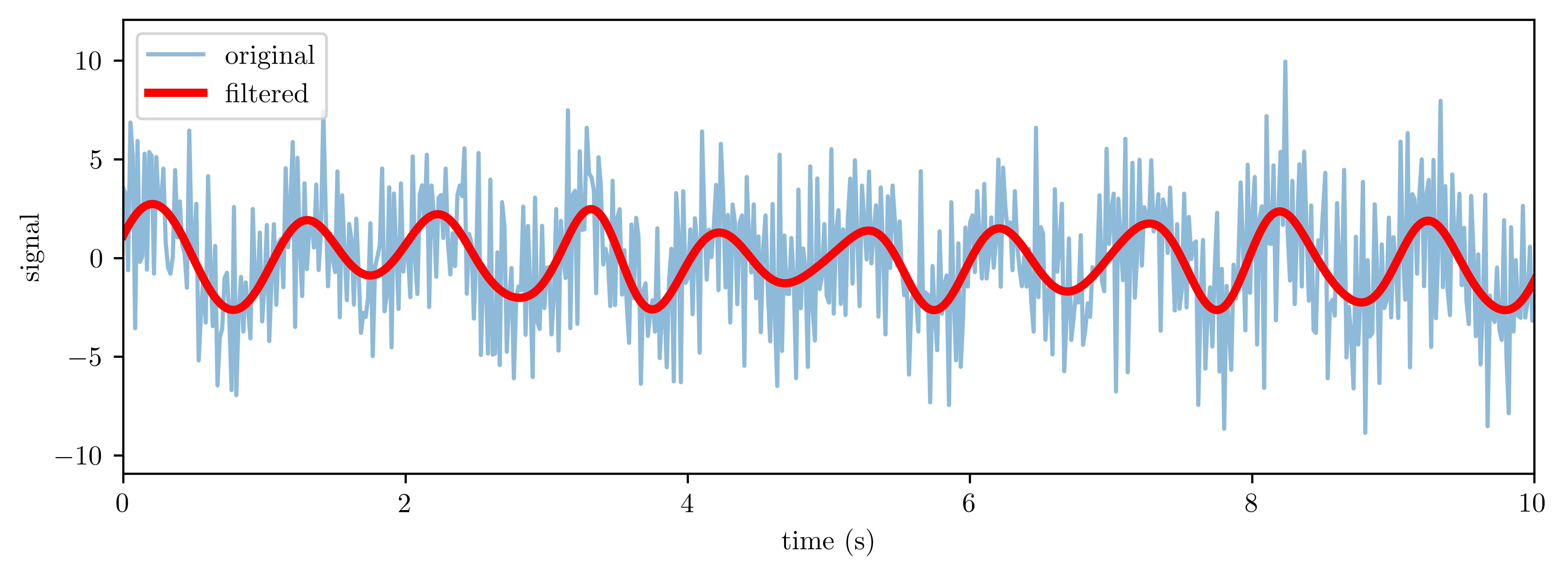
Windowing
fig, ax = plt.subplots(1, 1, figsize=(8, 3))
N = 100
ax.plot(signal.windows.blackman(N), label="Blackman")
ax.plot(signal.windows.hann(N), label="Hann")
ax.plot(signal.windows.hamming(N), label="Hamming")
ax.plot(signal.windows.gaussian(N, N / 5), label="Gaussian (std=N/5)")
ax.plot(signal.windows.kaiser(N, 7), label="Kaiser (beta=7)")
ax.set_xlabel("n")
ax.legend(loc=0)
fig.tight_layout()
fig.savefig("ch17-window-functions.pdf")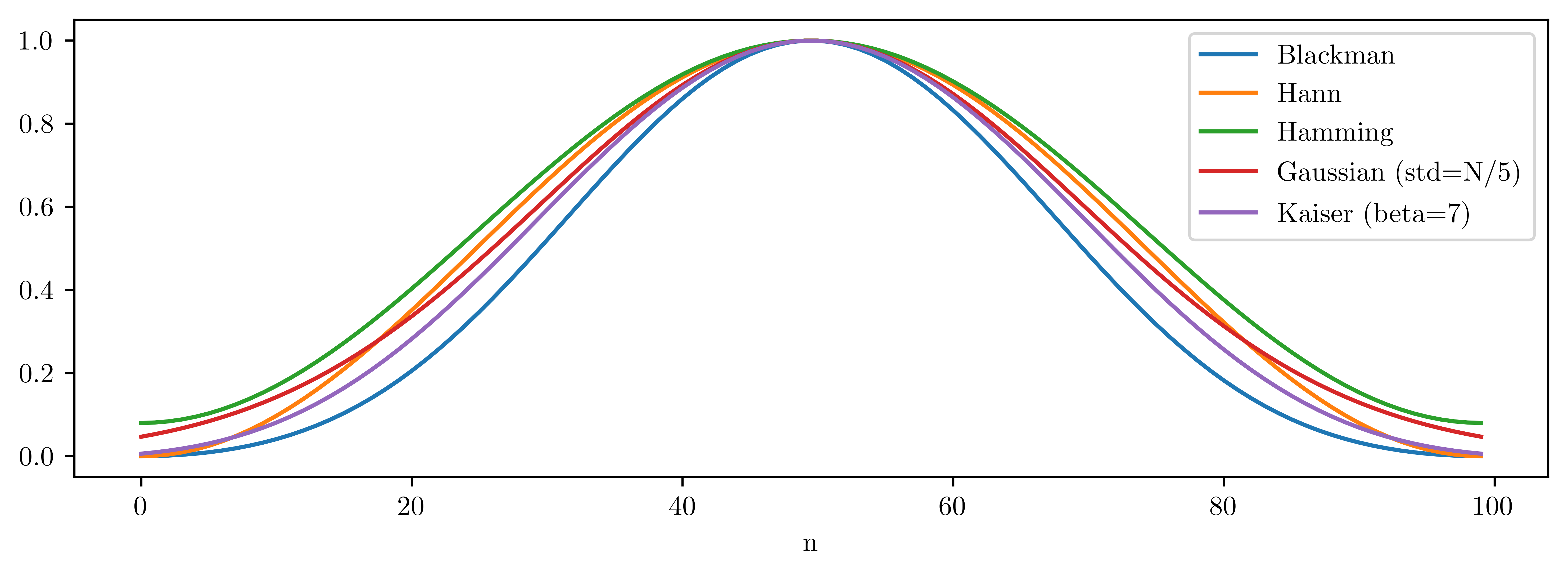
df = pd.read_csv(
    "temperature_outdoor_2014.tsv", delimiter="\t", names=["time", "temperature"]
)
df.time = (
pd.to_datetime(df.time.values, unit="s")
.tz_localize("UTC")
.tz_convert("Europe/Stockholm")
)df = df.set_index("time")df = df.resample("1H").ffill()/tmp/ipykernel_52107/1662368164.py:1: FutureWarning: 'H' is deprecated and will be removed in a future version, please use 'h' instead.
df = df.resample("1H").ffill()
df = df[(df.index >= "2014-01-01") * (df.index < "2014-06-01")].dropna()df = df[(df.index >= "2014-04-01") * (df.index < "2014-06-01")].dropna()time = df.index.astype("int") / 1e9temperature = df.temperature.valuestemperature_detrended = signal.detrend(temperature)window = signal.windows.blackman(len(temperature_detrended))temperature_windowed = temperature * windowdata_fft = fftpack.fft(temperature)
data_fft_detrended = fftpack.fft(temperature_detrended)
data_fft_windowed = fftpack.fft(temperature_windowed)fig, ax = plt.subplots(figsize=(12, 4))
ax.plot(df.index, temperature, label="original")
# ax.plot(df.index, temperature_detrended, label="detrended")
ax.plot(df.index, temperature_windowed, label="windowed")
ax.set_ylabel("temperature", fontsize=14)
ax.legend(loc=0)
fig.tight_layout()
fig.savefig("ch17-temperature-signal.pdf")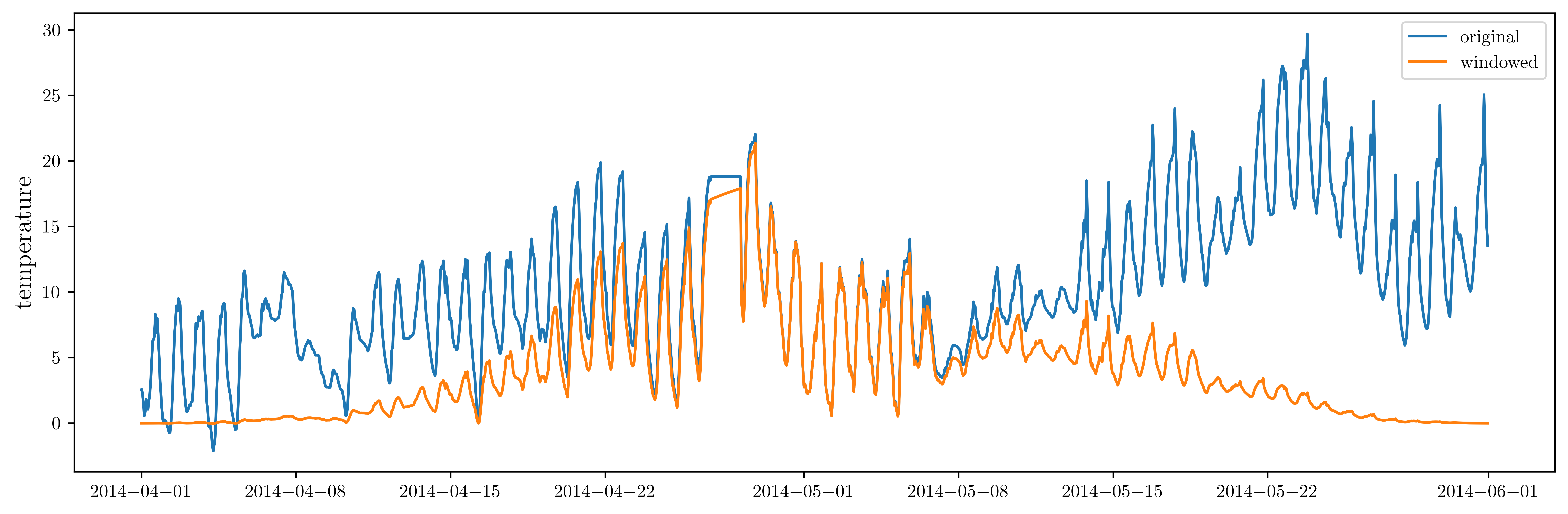
fig, ax = plt.subplots(figsize=(12, 4))
ax.plot(df.index, temperature_windowed, label="original")
ax.plot(df.index, temperature_detrended * window, label="windowed")
ax.set_ylabel("detrended temperature", fontsize=14)
ax.legend(loc=0)
fig.tight_layout()
# fig.savefig("ch17-temperature-signal.pdf")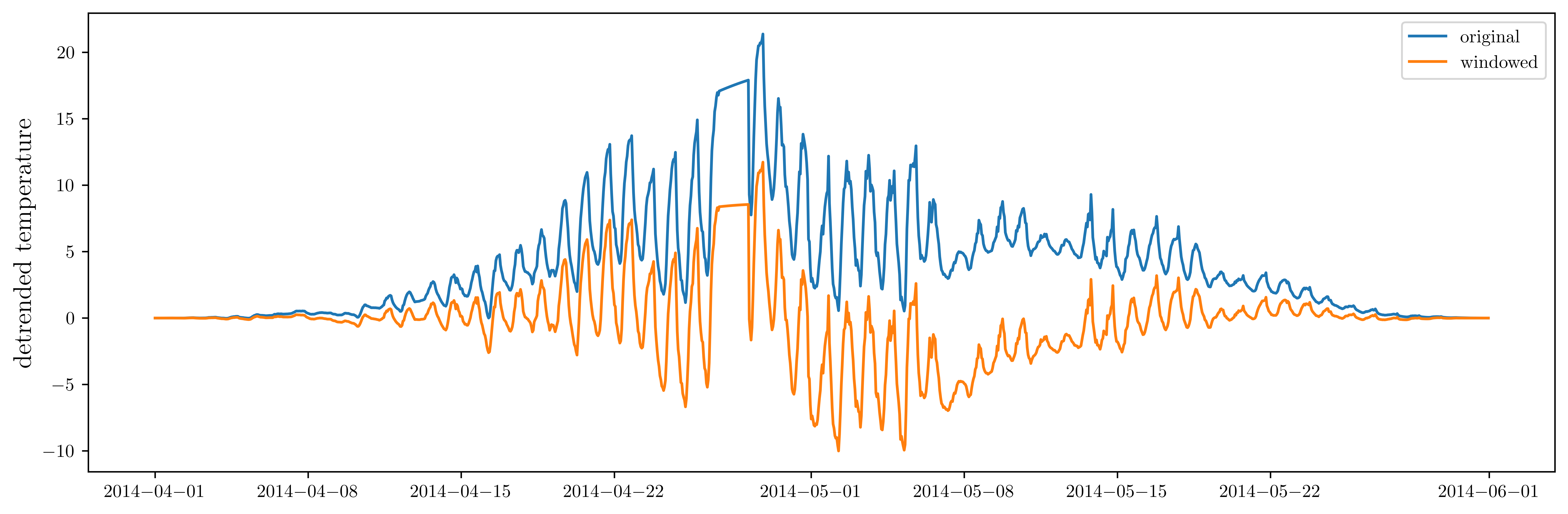
f = fftpack.fftfreq(len(temperature_windowed), time[1] - time[0])mask = f > 0fig, ax = plt.subplots(figsize=(12, 4))
ax.set_xlim(0.000001, 0.000025)
# ax.set_xlim(0.000005, 0.000018)
ax.set_xlim(0.000005, 0.00004)
ax.axvline(1.0 / 86400, color="r", lw=0.5)
ax.axvline(2.0 / 86400, color="r", lw=0.5)
ax.axvline(3.0 / 86400, color="r", lw=0.5)
ax.plot(f[mask], np.log(abs(data_fft[mask]) ** 2), lw=2, label="original")
# ax.plot(f[mask], np.log(abs(data_fft_detrended[mask])**2), lw=2, label="detrended")
# ax.plot(f[mask], np.log(abs(data_fft_windowed[mask])**2), lw=2, label="windowed")
ax.set_ylabel("$\log|F|$", fontsize=14)
ax.set_xlabel("frequency (Hz)", fontsize=14)
ax.legend(loc=0)
fig.tight_layout()
fig.savefig("ch17-temperature-spectrum.pdf")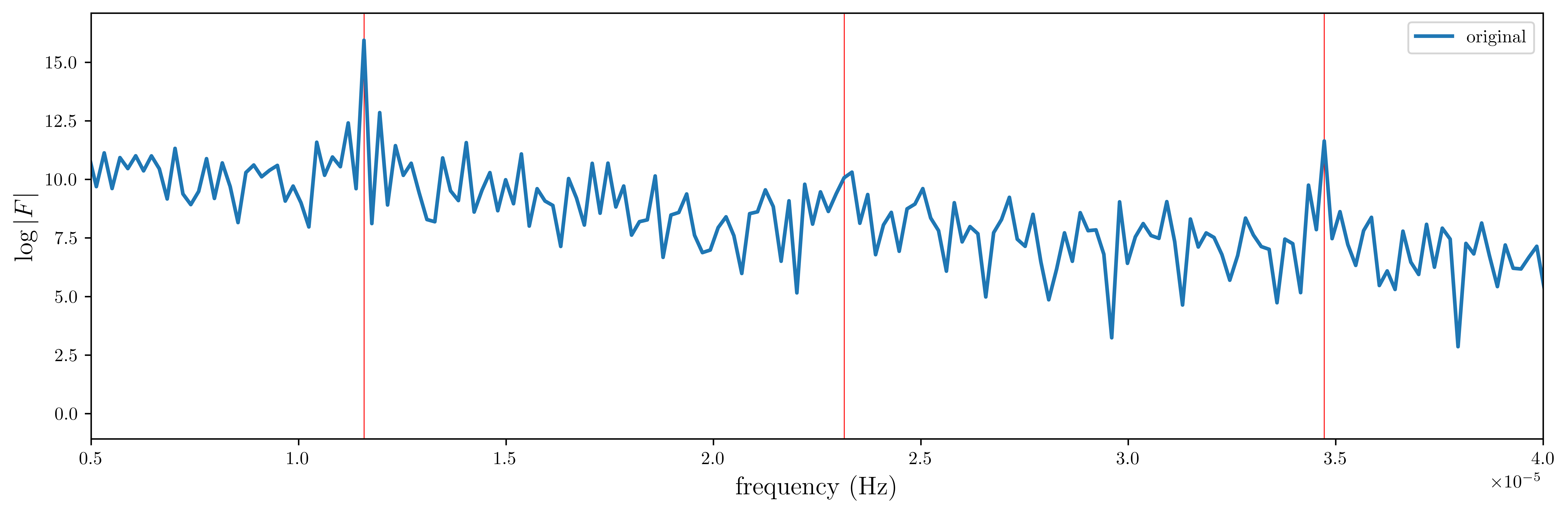
fig, ax = plt.subplots(figsize=(8, 3))
# ax.set_xlim(0.000001, 0.000025)
# ax.set_xlim(0.000005, 0.000018)
ax.set_xlim(0.000005, 0.00004)

ax.axvline(1.0 / 86400, color="r", lw=0.5)
ax.axvline(2.0 / 86400, color="r", lw=0.5)
ax.axvline(3.0 / 86400, color="r", lw=0.5)

y = np.log(abs(data_fft[mask]) ** 2)
ax.plot(f[mask], y / y[10:].max(), lw=1, label="original")

y = np.log(abs(data_fft_detrended[mask]) ** 2)
ax.plot(f[mask], y / y[10:].max(), lw=2, label="detrended")

y = np.log(abs(data_fft_windowed[mask]) ** 2)
ax.plot(f[mask], y / y[10:].max(), lw=2, label="windowed")

ax.set_ylabel("$\log|F|$", fontsize=14)
ax.set_xlabel("frequency (Hz)", fontsize=14)
ax.legend(loc=0)
fig.tight_layout()
fig.savefig("ch17-temperature-spectrum.pdf")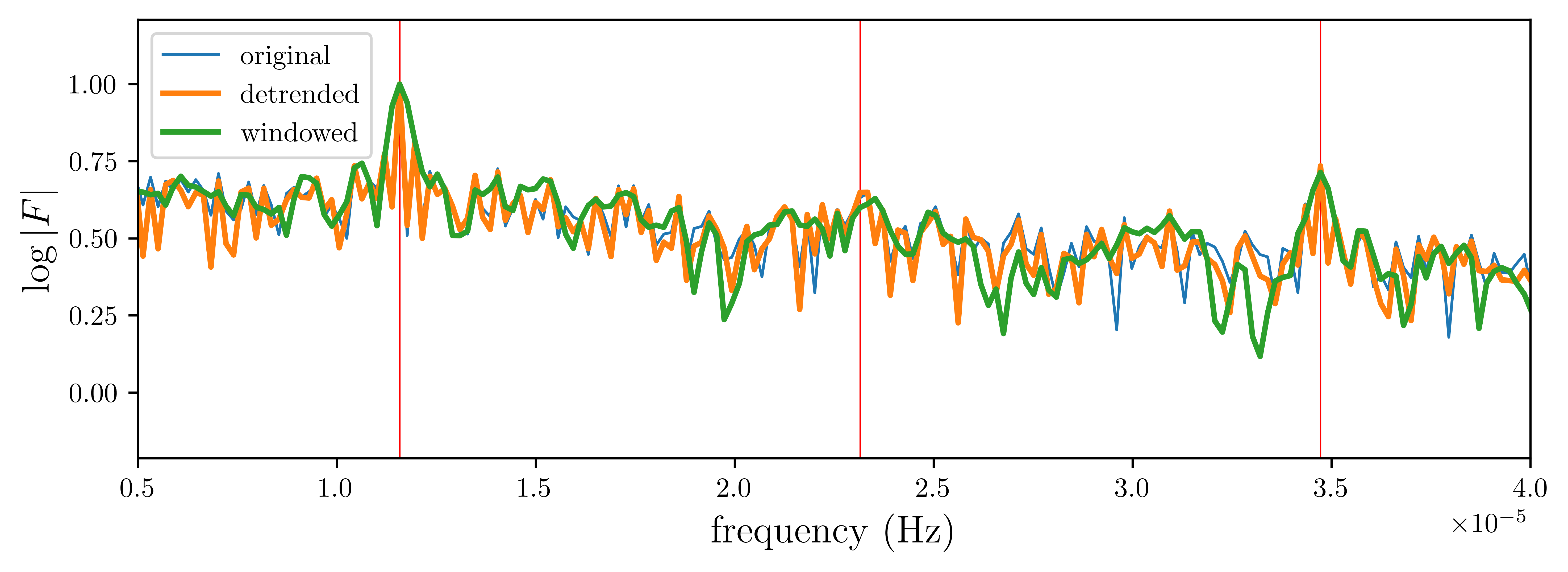
Spectrogram of Guitar sound
# https://www.freesound.org/people/guitarguy1985/sounds/52047/sample_rate, data = io.wavfile.read("guitar.wav")sample_rate44100data.shape(1181625, 2)data = data.mean(axis=1)data.shape[0] / sample_rate26.79421768707483N = int(sample_rate / 2.0)
N # half a second22050f = fftpack.fftfreq(N, 1.0 / sample_rate)t = np.linspace(0, 0.5, N)mask = (f > 0) * (f < 1000)subdata = data[:N]F = fftpack.fft(subdata)fig, axes = plt.subplots(1, 2, figsize=(12, 3))
axes[0].plot(t, subdata)
axes[0].set_ylabel("signal", fontsize=14)
axes[0].set_xlabel("time (s)", fontsize=14)
axes[1].plot(f[mask], abs(F[mask]))
axes[1].set_ylabel("$|F|$", fontsize=14)
axes[1].set_xlabel("Frequency (Hz)", fontsize=14)
fig.tight_layout()
fig.savefig("ch17-guitar-spectrum.pdf")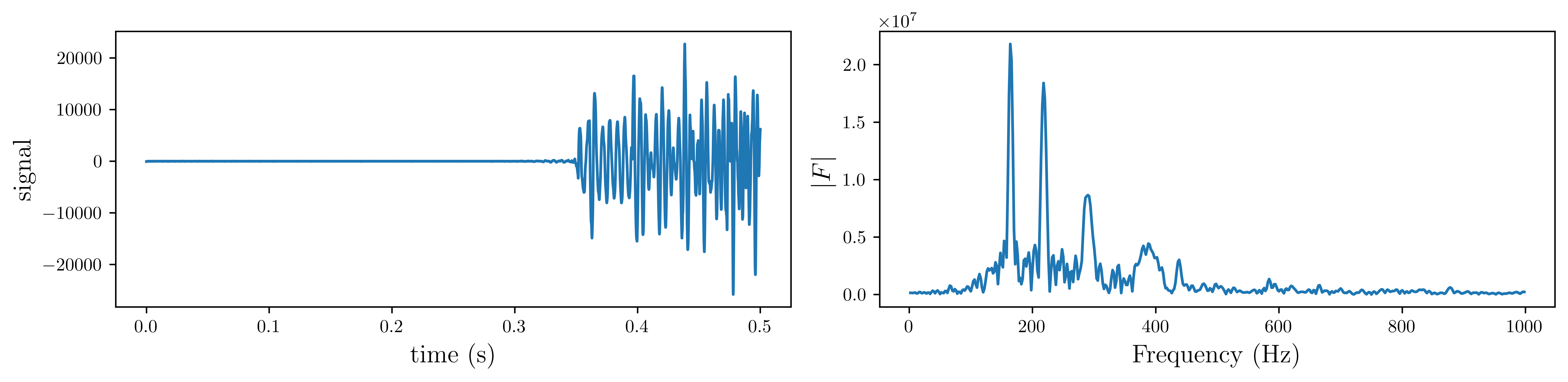
fig, axes = plt.subplots(1, 2, figsize=(12, 3))
axes[0].plot(t, subdata)
axes[0].set_ylabel("signal", fontsize=14)
axes[0].set_xlabel("time (s)", fontsize=14)
axes[1].plot(f[mask], abs(F[mask]))
axes[1].set_ylabel("$|F|$", fontsize=14)
axes[1].set_xlabel("Frequency (Hz)", fontsize=14)


f_A4 = 440
a = 2 ** (1 / 12)
for note, frequency in [
    # ('A2', f_A4 * a**(-12-12)),
    # ('B2', f_A4 * a**(-10-12)),
    # ('C3', f_A4 * a**(-9-12)),
    # ('D3', f_A4 * a**(-7-12)),
    ("F3", f_A4 * a ** (-6 - 12)),
    ("G3", f_A4 * a ** (-4 - 12)),
    # ('F3', f_A4 * a**(-2-12)),
    ("A3", f_A4 * a ** (-12)),
    # ('B3', f_A4 * a**(-10)),
    # ('C4', f_A4 * a**(-9)),
    ("D4", f_A4 * a ** (-7)),
    # ('F4', f_A4 * a**(-6)),
    # ('G4', f_A4 * a**(-4)),
    ("F4", f_A4 * a ** (-2)),
    ("A4", f_A4),
]:
    axes[1].axvline(frequency, color="black", alpha=0.5)
    axes[1].text(frequency * 1.01, 2e7, note, fontsize=6)

fig.tight_layout()
fig.savefig("ch17-guitar-spectrum.pdf")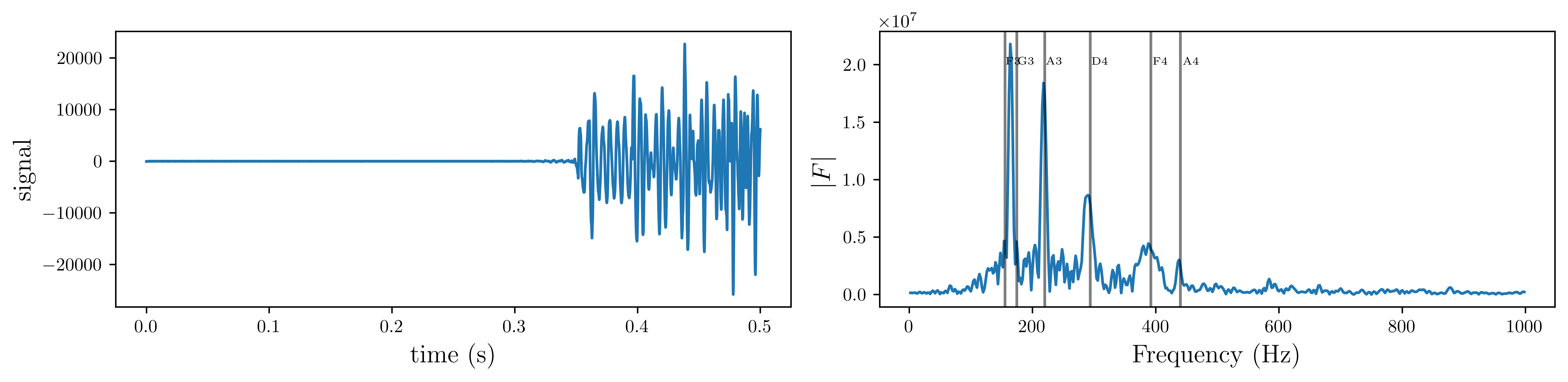
N_max = int(data.shape[0] / N)f_values = np.sum(1 * mask)spect_data = np.zeros((N_max, f_values))window = signal.windows.blackman(len(subdata))for n in range(0, N_max):
subdata = data[(N * n) : (N * (n + 1))]
F = fftpack.fft(subdata * window)
spect_data[n, :] = np.log(abs(F[mask]))fig, ax = plt.subplots(1, 1, figsize=(8, 6))
p = ax.imshow(
spect_data,
origin="lower",
extent=(0, 1000, 0, data.shape[0] / sample_rate),
aspect="auto",
cmap=mpl.cm.RdBu_r,
)
cb = fig.colorbar(p, ax=ax)
cb.set_label("$\log|F|$", fontsize=16)
ax.set_ylabel("time (s)", fontsize=14)
ax.set_xlabel("Frequency (Hz)", fontsize=14)
f_A4 = 440
a = 2 ** (1 / 12)
for note, frequency in [
# ('A2', f_A4 * a**(-12-12)),
# ('B2', f_A4 * a**(-10-12)),
# ('C3', f_A4 * a**(-9-12)),
("D3", f_A4 * a ** (-7 - 12)),
# ('F3', f_A4 * a**(-6-12)),
("G3", f_A4 * a ** (-4 - 12)),
("F3", f_A4 * a ** (-2 - 12)),
("A3", f_A4 * a ** (-12)),
("B3", f_A4 * a ** (-10)),
("C4", f_A4 * a ** (-9)),
("D4", f_A4 * a ** (-7)),
# ('F4', f_A4 * a**(-6)),
("G4", f_A4 * a ** (-4)),
("F4", f_A4 * a ** (-2)),
("A4", f_A4),
("B4", f_A4 * a ** (2)),
("C5", f_A4 * a ** (3)),
("D5", f_A4 * a ** (5)),
("F5", f_A4 * a ** (6)),
("G5", f_A4 * a ** (8)),
("F5", f_A4 * a ** (10)),
("A5", f_A4 * a ** (12)),
]:
# ax.axvline(frequency, color="black", alpha=0.5)
ax.text(frequency - 10, 27, note, fontsize=6)
fig.tight_layout()
fig.savefig("ch17-spectrogram.pdf")
fig.savefig("ch17-spectrogram.png")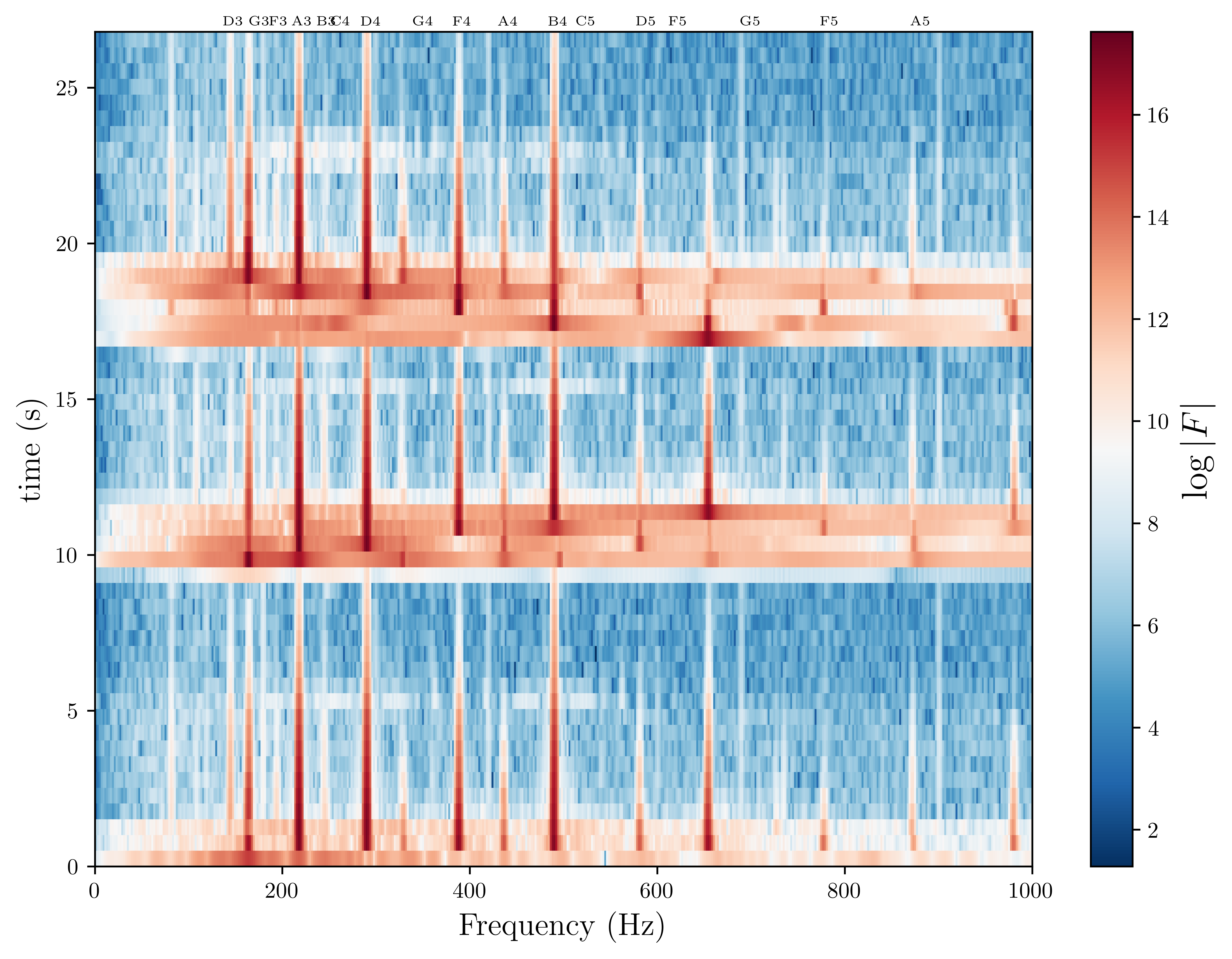
fig, ax = plt.subplots(1, 1, figsize=(8, 6))
p = ax.imshow(
    spect_data,
    origin="lower",
    extent=(0, 1000, 0, data.shape[0] / sample_rate),
    aspect="auto",
    cmap=mpl.cm.RdBu_r,
)
cb = fig.colorbar(p, ax=ax)
cb.set_label("$\log|F|$", fontsize=16)
ax.set_ylabel("time (s)", fontsize=14)
ax.set_xlabel("Frequency (Hz)", fontsize=14)
fig.tight_layout()
fig.savefig("ch17-spectrogram.pdf")
fig.savefig("ch17-spectrogram.png")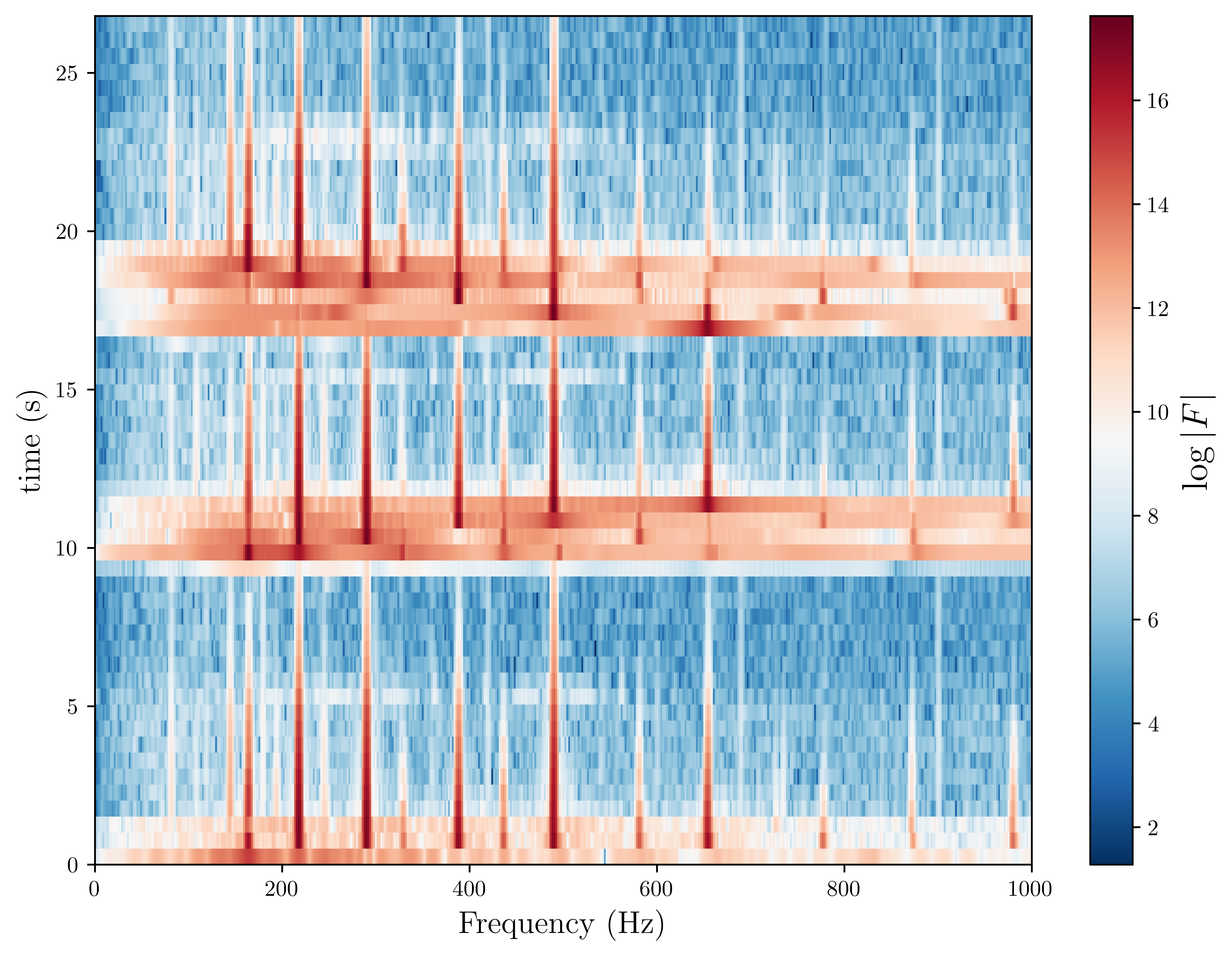
Signal filters
Convolution filters
# restore variables from the first example
np.random.seed(0)
B = 30.0
f_s = 2 * B
delta_f = 0.01
N = int(f_s / delta_f)
T = N / f_s
t = np.linspace(0, T, N)
f_t = signal_samples(t)
f = fftpack.fftfreq(N, 1 / f_s)
H = abs(f) < 2h = fftpack.fftshift(fftpack.ifft(H))f_t_filtered_conv = signal.convolve(f_t, h, mode="same")fig = plt.figure(figsize=(8, 6))
ax = plt.subplot2grid((2, 2), (0, 0))
ax.plot(f, H)
ax.set_xlabel("frequency (Hz)")
ax.set_ylabel("Frequency filter")
ax.set_ylim(0, 1.5)
ax = plt.subplot2grid((2, 2), (0, 1))
ax.plot(t - t[-1] / 2.0, h.real)
ax.set_xlabel("time (s)")
ax.set_ylabel("convolution kernel")
ax = plt.subplot2grid((2, 2), (1, 0), colspan=2)
ax.plot(t, f_t, label="original", alpha=0.25)
ax.plot(t, f_t_filtered.real, "r", lw=2, label="filtered in frequency domain")
ax.plot(t, f_t_filtered_conv.real, "b--", lw=2, label="filtered with convolution")
ax.set_xlim(0, 10)
ax.set_xlabel("time (s)")
ax.set_ylabel("signal")
ax.legend(loc=2)
fig.tight_layout()
fig.savefig("ch17-convolution-filter.pdf")
fig.savefig("ch17-convolution-filter.png")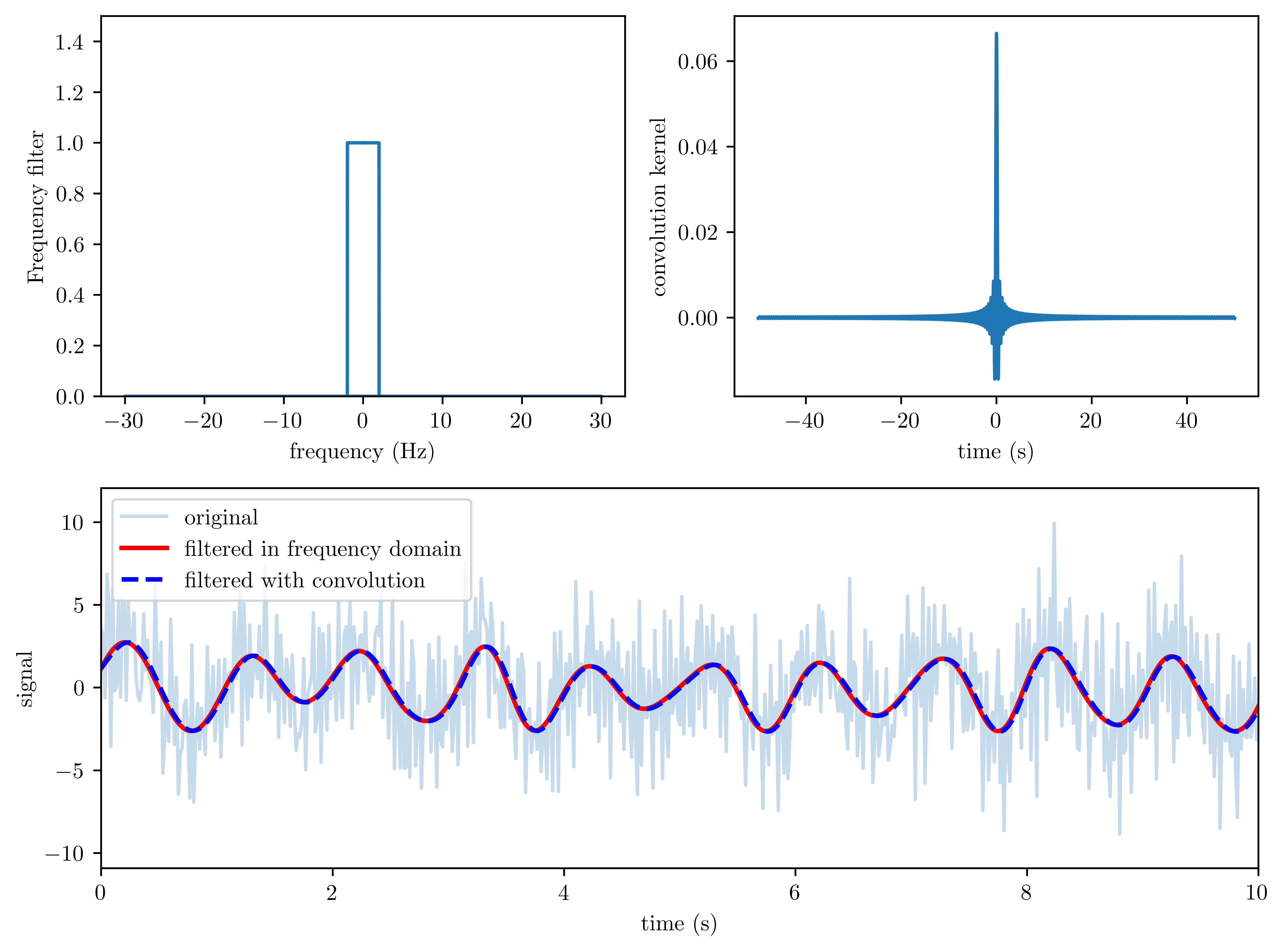
FIR filter
n = 101f_s = 1.0 / 3600nyq = f_s / 2b = signal.firwin(n, cutoff=nyq / 12, fs=nyq, window="hamming")plt.plot(b);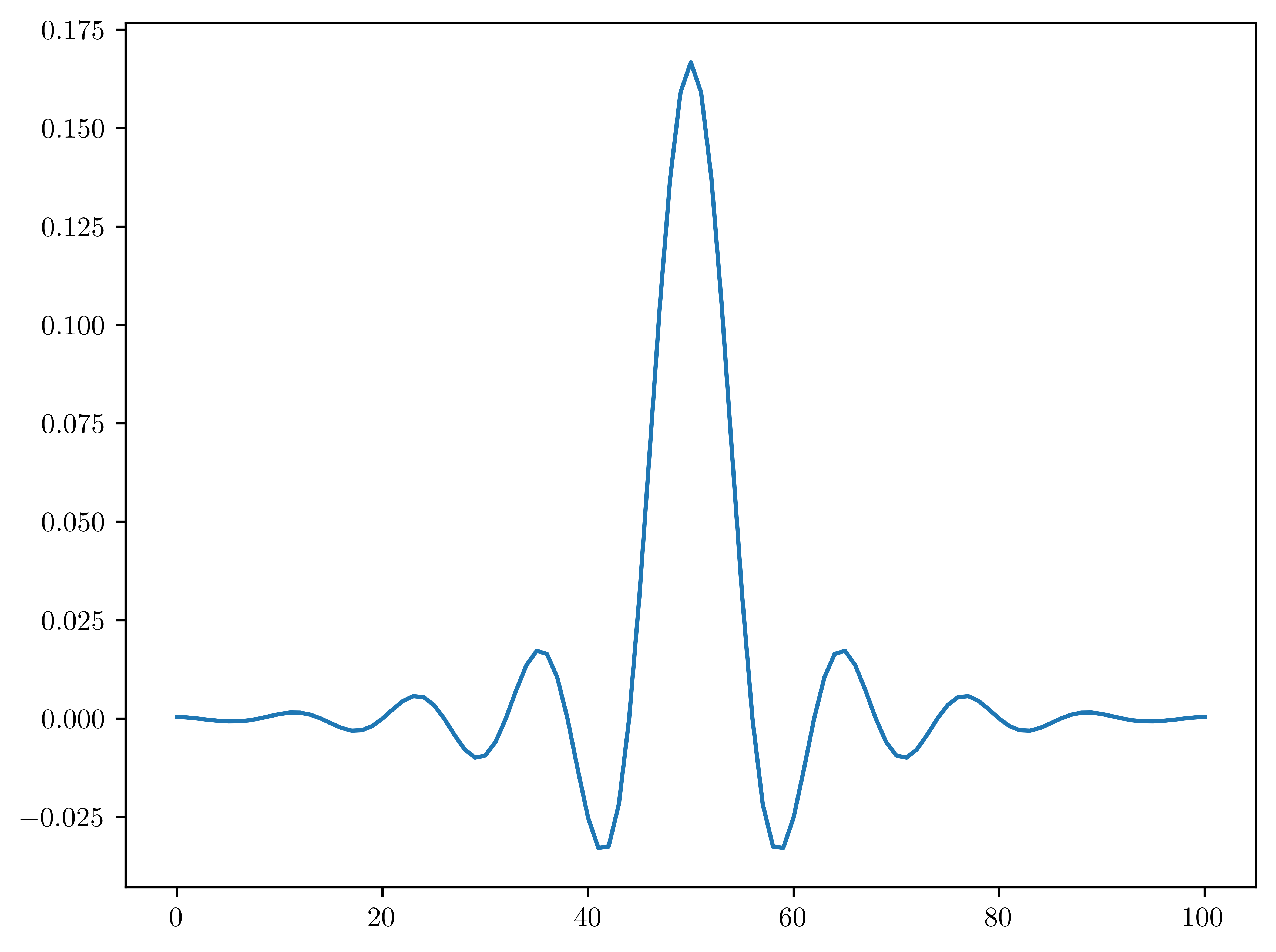
f, h = signal.freqz(b)fig, ax = plt.subplots(1, 1, figsize=(8, 3))
h_ampl = 20 * np.log10(abs(h))
h_phase = np.unwrap(np.angle(h))
ax.plot(f / max(f), h_ampl, "b")
ax.set_ylim(-150, 5)
ax.set_ylabel("frequency response (dB)", color="b")
ax.set_xlabel(r"normalized frequency")
ax = ax.twinx()
ax.plot(f / max(f), h_phase, "r")
ax.set_ylabel("phase response", color="r")
ax.axvline(1.0 / 12, color="black")
fig.tight_layout()
fig.savefig("ch17-filter-frequency-response.pdf")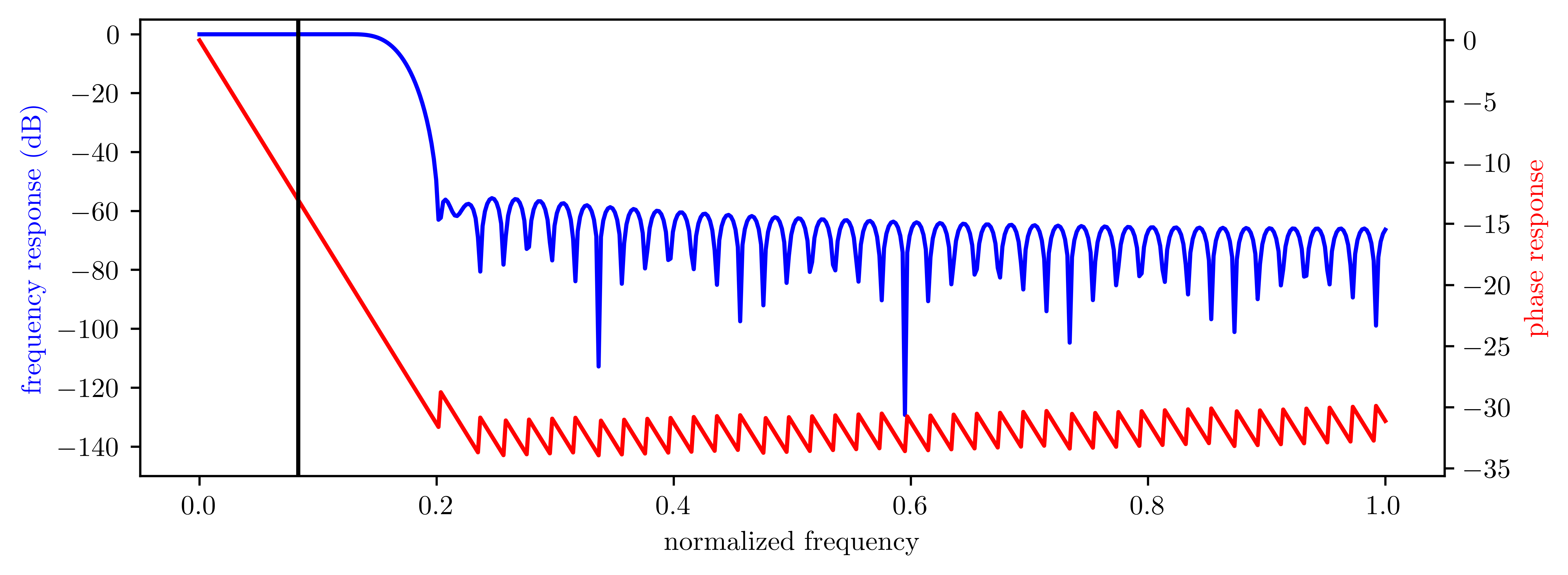
temperature_filtered = signal.lfilter(b, 1, temperature)temperature_median_filtered = signal.medfilt(temperature, 25)fig, ax = plt.subplots(figsize=(12, 4))
ax.plot(df.index, temperature, label="original", alpha=0.5)
ax.plot(df.index, temperature_filtered, color="green", lw=2, label="FIR")
ax.plot(df.index, temperature_median_filtered, color="red", lw=2, label="median filer")
ax.set_ylabel("temperature", fontsize=14)
ax.legend(loc=0)
fig.tight_layout()
fig.savefig("ch17-temperature-signal-fir.pdf")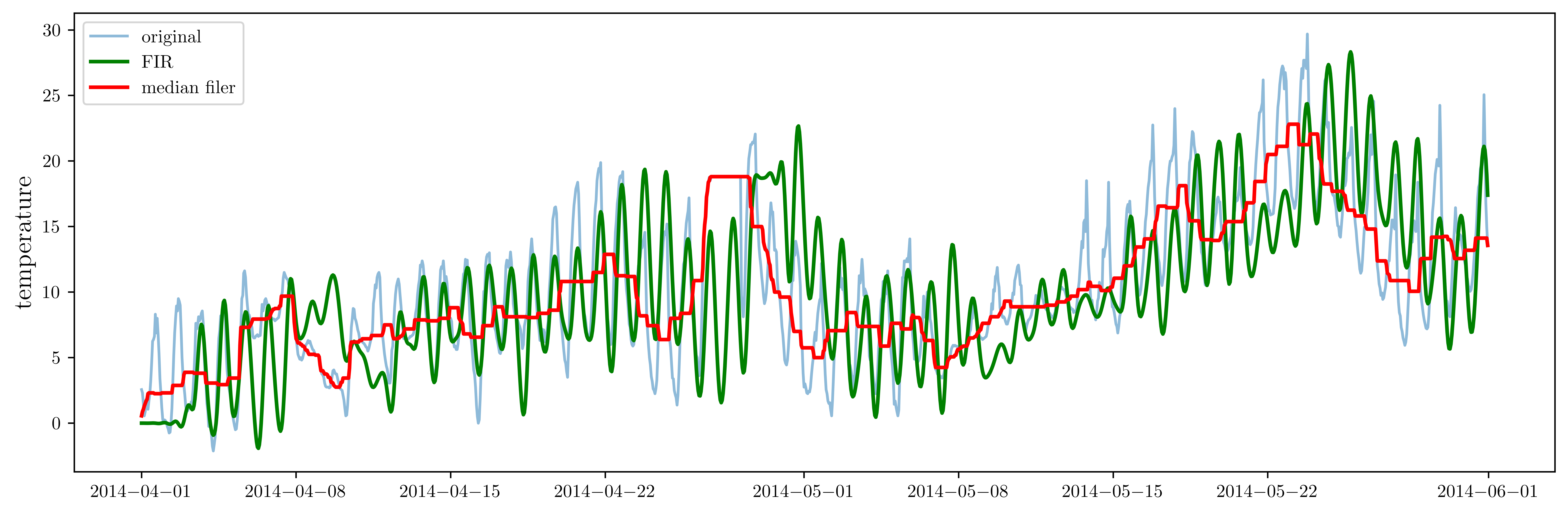
IIR filter
b, a = signal.butter(2, 14 / 365.0, btype="high")barray([ 0.91831745, -1.8366349 , 0.91831745])aarray([ 1. , -1.82995169, 0.8433181 ])temperature_filtered_iir = signal.lfilter(b, a, temperature)temperature_filtered_filtfilt = signal.filtfilt(b, a, temperature)fig, ax = plt.subplots(figsize=(8, 3))
ax.plot(df.index, temperature, label="original", alpha=0.5)
ax.plot(df.index, temperature_filtered_iir, color="red", label="IIR filter")
ax.plot(
df.index, temperature_filtered_filtfilt, color="green", label="filtfilt filtered"
)
ax.set_ylabel("temperature", fontsize=14)
ax.legend(loc=0)
fig.tight_layout()
fig.savefig("ch17-temperature-signal-iir.pdf")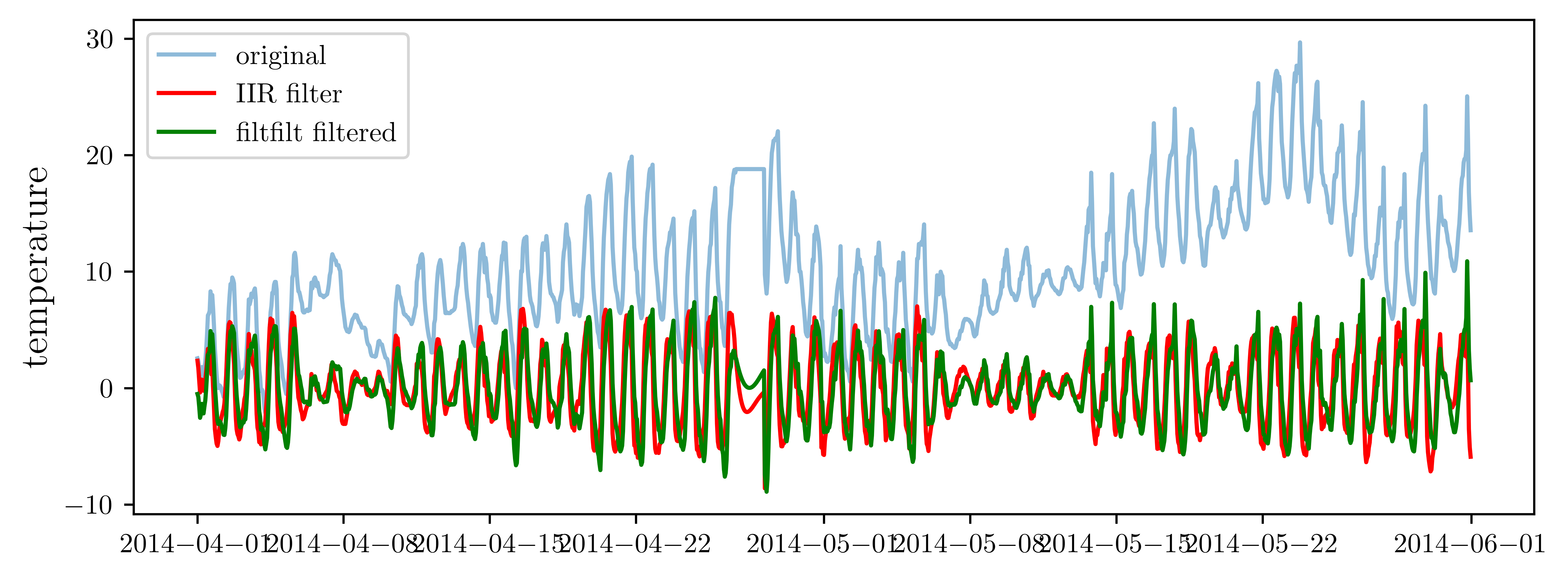
# f, h = signal.freqz(b, a)fig, ax = plt.subplots(1, 1, figsize=(8, 3))
h_ampl = 20 * np.log10(abs(h))
h_phase = np.unwrap(np.angle(h))
ax.plot(f / max(f) / 100, h_ampl, "b")
ax.set_ylabel("frequency response (dB)", color="b")
ax.set_xlabel(r"normalized frequency")
ax = ax.twinx()
ax.plot(f / max(f) / 100, h_phase, "r")
ax.set_ylabel("phase response", color="r")
fig.tight_layout()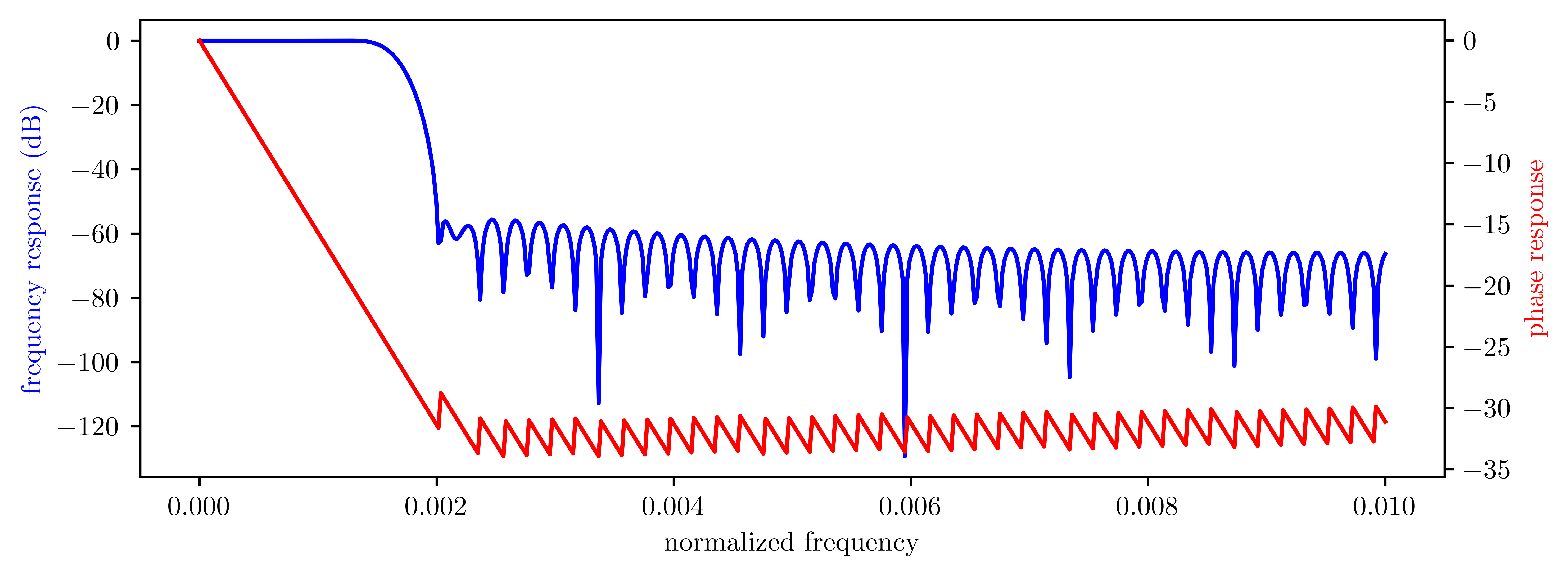
Filtering Audio
b = np.zeros(5000)
b[0] = b[-1] = 1
b /= b.sum()
data_filt = signal.lfilter(b, 1, data)io.wavfile.write(
"guitar-echo.wav", sample_rate, np.vstack([data_filt, data_filt]).T.astype(np.int16)
)# based on: http://nbviewer.ipython.org/gist/Carreau/5507501/the%20sound%20of%20hydrogen.ipynb
from IPython.core.display import HTML
from IPython.display import display
def wav_player(filepath):
src = """
<audio controls="controls" style="width:600px" >
<source src="%s" type="audio/wav" />
</audio>
""" % (filepath)
display(HTML(src))wav_player("guitar.wav")Loading...
wav_player("guitar-echo.wav")Loading...
- Johansson, R. (2024). Numerical Python: Scientific Computing and Data Science Applications with Numpy, SciPy and Matplotlib. Apress. 10.1007/979-8-8688-0413-7