Chapter 8: Integration
Robert Johansson
Source code listings for Numerical Python - Scientific Computing and Data Science Applications with Numpy, SciPy and Matplotlib (ISBN 979-8-8688-0412-0).
%matplotlib inline
import matplotlib as mpl
import matplotlib.pyplot as plt

mpl.rcParams["mathtext.fontset"] = "stix"
mpl.rcParams["font.family"] = "serif"
mpl.rcParams["font.sans-serif"] = "stix"
import numpy as npfrom scipy import integrateimport mpmath
import sympysympy.init_printing()Simpson’s rule
a, b, X = sympy.symbols("a, b, x")
f = sympy.Function("f")
# x = a, (a+b)/3, 2 * (a+b)/3, b # 3rd order quadrature rule
x = a, (a + b) / 2, b # simpson's rule
# x = a, b # trapezoid rule
# x = ((b+a)/2,) # mid-point rulew = [sympy.symbols("w_%d" % i) for i in range(len(x))]q_rule = sum([w[i] * f(x[i]) for i in range(len(x))])q_ruleLoading...
phi = [sympy.Lambda(X, X**n) for n in range(len(x))]phiLoading...
eqs = [
    q_rule.subs(f, phi[n]) - sympy.integrate(phi[n](X), (X, a, b))
    for n in range(len(phi))
]eqsLoading...
w_sol = sympy.solve(eqs, w)w_solLoading...
q_rule.subs(w_sol).simplify()Loading...
SciPy integrate
Simple integration example
def f(x):
    return np.exp(-(x**2))
val, err = integrate.quad(f, -1, 1)valLoading...
errLoading...
Extra arguments
def f(x, a, b, c):
    return a * np.exp(-(((x - b) / c) ** 2))
val, err = integrate.quad(f, -1, 1, args=(1, 2, 3))valLoading...
errLoading...
Reshuffle arguments
from scipy.special import jvval, err = integrate.quad(lambda x: jv(0, x), 0, 5)valLoading...
errLoading...
Infinite limits
f = lambda x: np.exp(-(x**2))val, err = integrate.quad(f, -np.inf, np.inf)valLoading...
errLoading...
Singularity
f = lambda x: 1 / np.sqrt(abs(x))a, b = -1, 1integrate.quad(f, a, b)/tmp/ipykernel_40722/592522017.py:1: RuntimeWarning: divide by zero encountered in scalar divide
f = lambda x: 1 / np.sqrt(abs(x))
Loading...
integrate.quad(f, a, b, points=[0])Loading...
fig, ax = plt.subplots(figsize=(8, 3))

x = np.linspace(a, b, 10000)
ax.plot(x, f(x), lw=2)
ax.fill_between(x, f(x), color="green", alpha=0.5)
ax.set_xlabel("$x$", fontsize=18)
ax.set_ylabel("$f(x)$", fontsize=18)
ax.set_ylim(0, 25)
ax.set_xlim(-1, 1)

fig.tight_layout()
fig.savefig("ch8-diverging-integrand.pdf")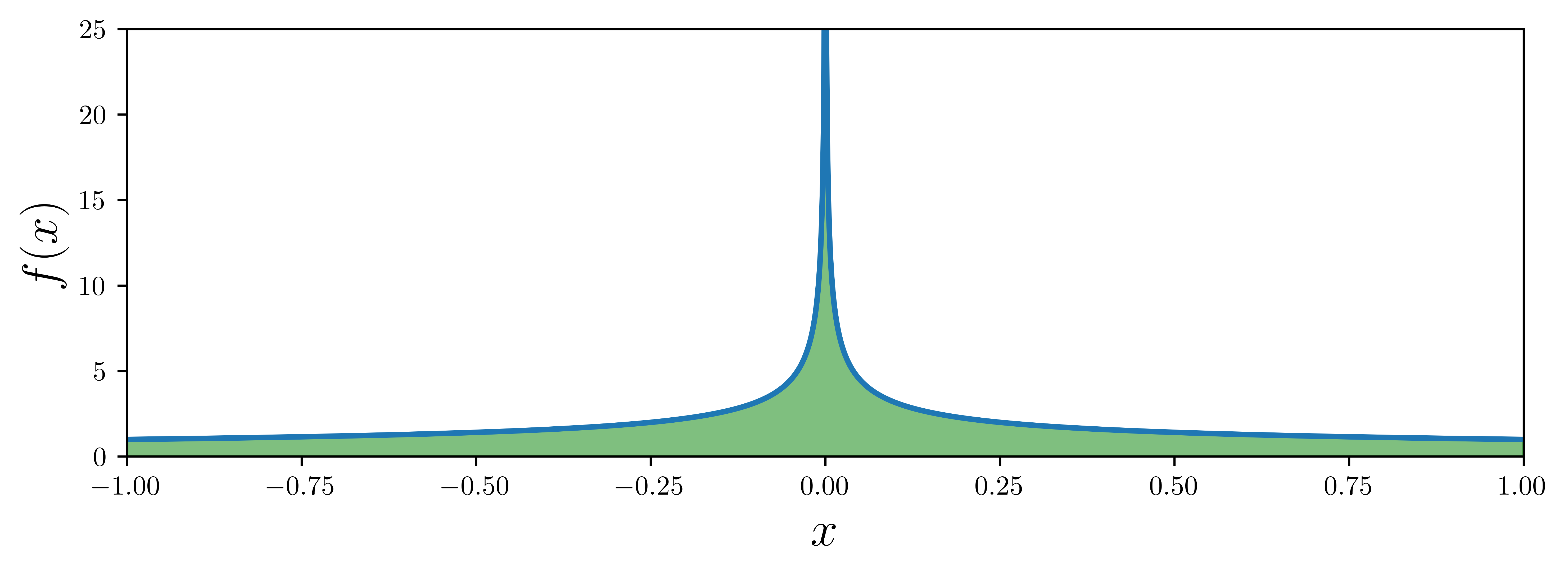
Tabulated integrand
f = lambda x: np.sqrt(x)a, b = 0, 2x = np.linspace(a, b, 25)y = f(x)fig, ax = plt.subplots(figsize=(8, 3))
ax.plot(x, y, "bo")
xx = np.linspace(a, b, 500)
ax.plot(xx, f(xx), "b-")
ax.fill_between(xx, f(xx), color="green", alpha=0.5)
ax.set_xlabel(r"$x$", fontsize=18)
ax.set_ylabel(r"$f(x)$", fontsize=18)
fig.tight_layout()
fig.savefig("ch8-tabulated-integrand.pdf")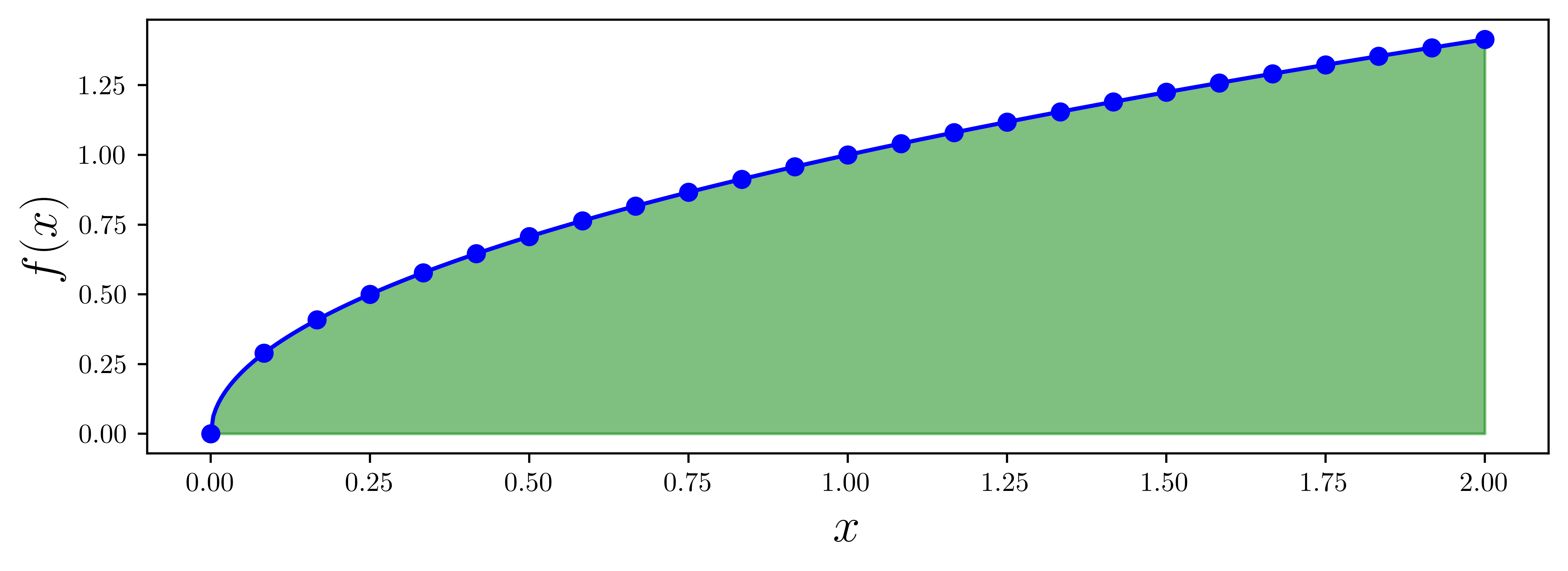
val_trapz = integrate.trapezoid(y, x)val_trapzLoading...
val_simps = integrate.simpson(y, x)val_simpsLoading...
val_exact = 2.0 / 3.0 * (b - a) ** (3.0 / 2.0)val_exactLoading...
val_exact - val_trapzLoading...
val_exact - val_simpsLoading...
x = np.linspace(a, b, 1 + 2**6)len(x)Loading...
y = f(x)val_exact - integrate.romb(y, dx=(x[1] - x[0]))Loading...
val_exact - integrate.simpson(y, dx=x[1] - x[0])Loading...
Higher dimension
def f(x):
    return np.exp(-(x**2))
%time integrate.quad(f, a, b)CPU times: user 49 μs, sys: 4 μs, total: 53 μs
Wall time: 57.7 μs
Loading...
def f(x, y):
    return np.exp(-(x**2) - y**2)
a, b = 0, 1g = lambda x: 0h = lambda x: 1integrate.dblquad(f, a, b, g, h)Loading...
integrate.dblquad(lambda x, y: np.exp(-(x**2) - y**2), 0, 1, lambda x: 0, lambda x: 1)Loading...
fig, ax = plt.subplots(figsize=(6, 5))

x = y = np.linspace(-1.25, 1.25, 75)
X, Y = np.meshgrid(x, y)

c = ax.contour(X, Y, f(X, Y), 15, cmap=mpl.cm.RdBu, vmin=-1, vmax=1)

bound_rect = plt.Rectangle((0, 0), 1, 1, facecolor="grey")
ax.add_patch(bound_rect)

ax.axis("tight")
ax.set_xlabel("$x$", fontsize=18)
ax.set_ylabel("$y$", fontsize=18)

fig.tight_layout()
fig.savefig("ch8-multi-dim-integrand.pdf")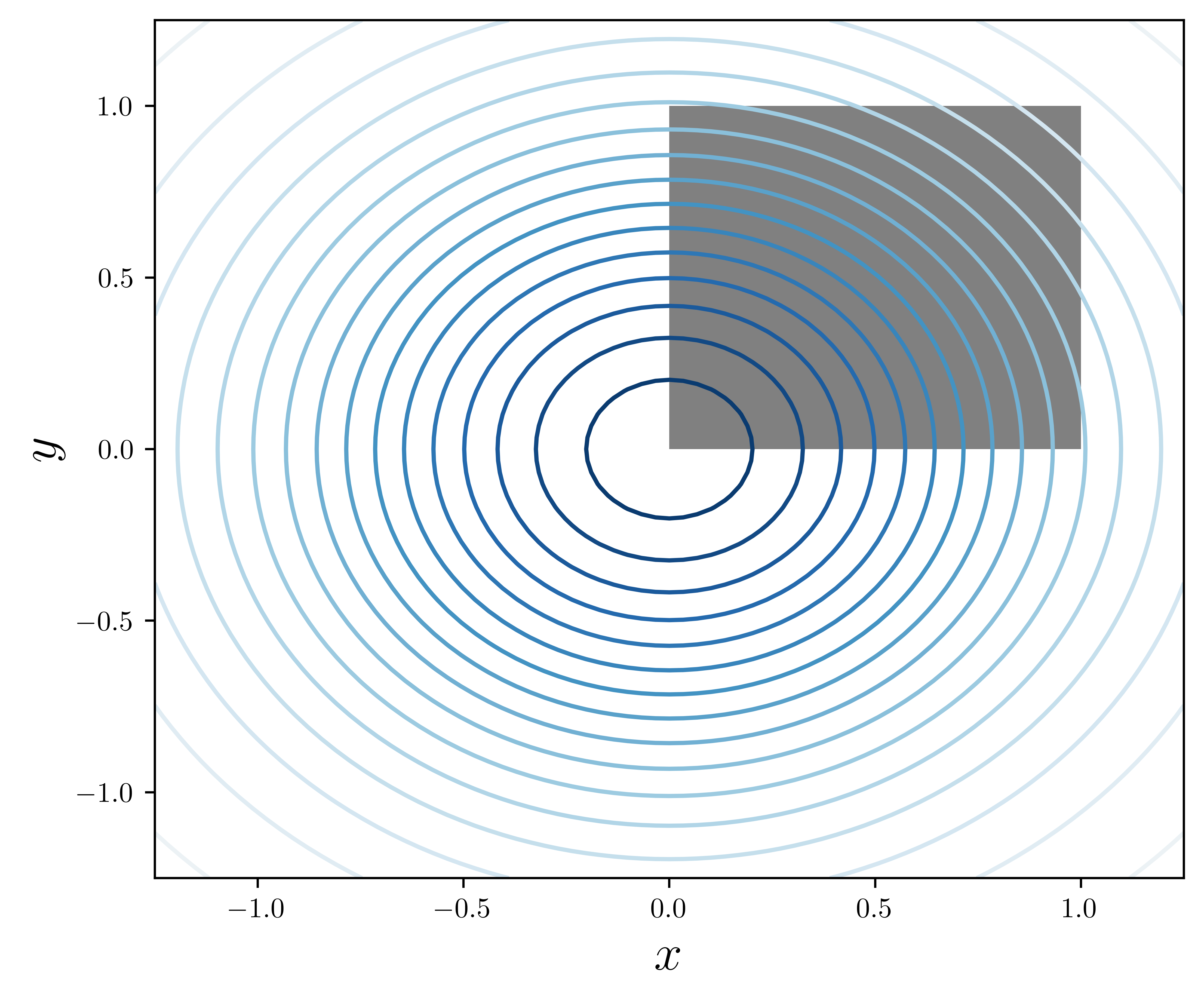
integrate.dblquad(f, 0, 1, lambda x: -1 + x, lambda x: 1 - x)Loading...
def f(x, y, z):
    return np.exp(-(x**2) - y**2 - z**2)
integrate.tplquad(f, 0, 1, lambda x: 0, lambda x: 1, lambda x, y: 0, lambda x, y: 1)Loading...
integrate.nquad(f, [(0, 1), (0, 1), (0, 1)])Loading...
nquad
def f(*args):
    return np.exp(-np.sum(np.array(args) ** 2))
%time integrate.nquad(f, [(0,1)] * 1)CPU times: user 322 μs, sys: 23 μs, total: 345 μs
Wall time: 350 μs
Loading...
%time integrate.nquad(f, [(0,1)] * 2)CPU times: user 1.86 ms, sys: 136 μs, total: 1.99 ms
Wall time: 1.99 ms
Loading...
%time integrate.nquad(f, [(0,1)] * 3)CPU times: user 55.4 ms, sys: 0 ns, total: 55.4 ms
Wall time: 55.2 ms
Loading...
%time integrate.nquad(f, [(0,1)] * 4)CPU times: user 696 ms, sys: 149 μs, total: 696 ms
Wall time: 697 ms
Loading...
%time integrate.nquad(f, [(0,1)] * 5)CPU times: user 15.3 s, sys: 5.31 ms, total: 15.3 s
Wall time: 15.3 s
Loading...
Monte Carlo integration
from skmonaco import mcquad%time val, err = mcquad(f, xl=np.zeros(5), xu=np.ones(5), npoints=100000)CPU times: user 440 ms, sys: 3.26 ms, total: 444 ms
Wall time: 447 ms
val, errLoading...
%time val, err = mcquad(f, xl=np.zeros(10), xu=np.ones(10), npoints=100000)CPU times: user 466 ms, sys: 0 ns, total: 466 ms
Wall time: 469 ms
val, errLoading...
Symbolic and multi-precision quadrature
x = sympy.symbols("x")f = 2 * sympy.sqrt(1 - x**2)a, b = -1, 1sympy.plot(f, (x, -2, 2));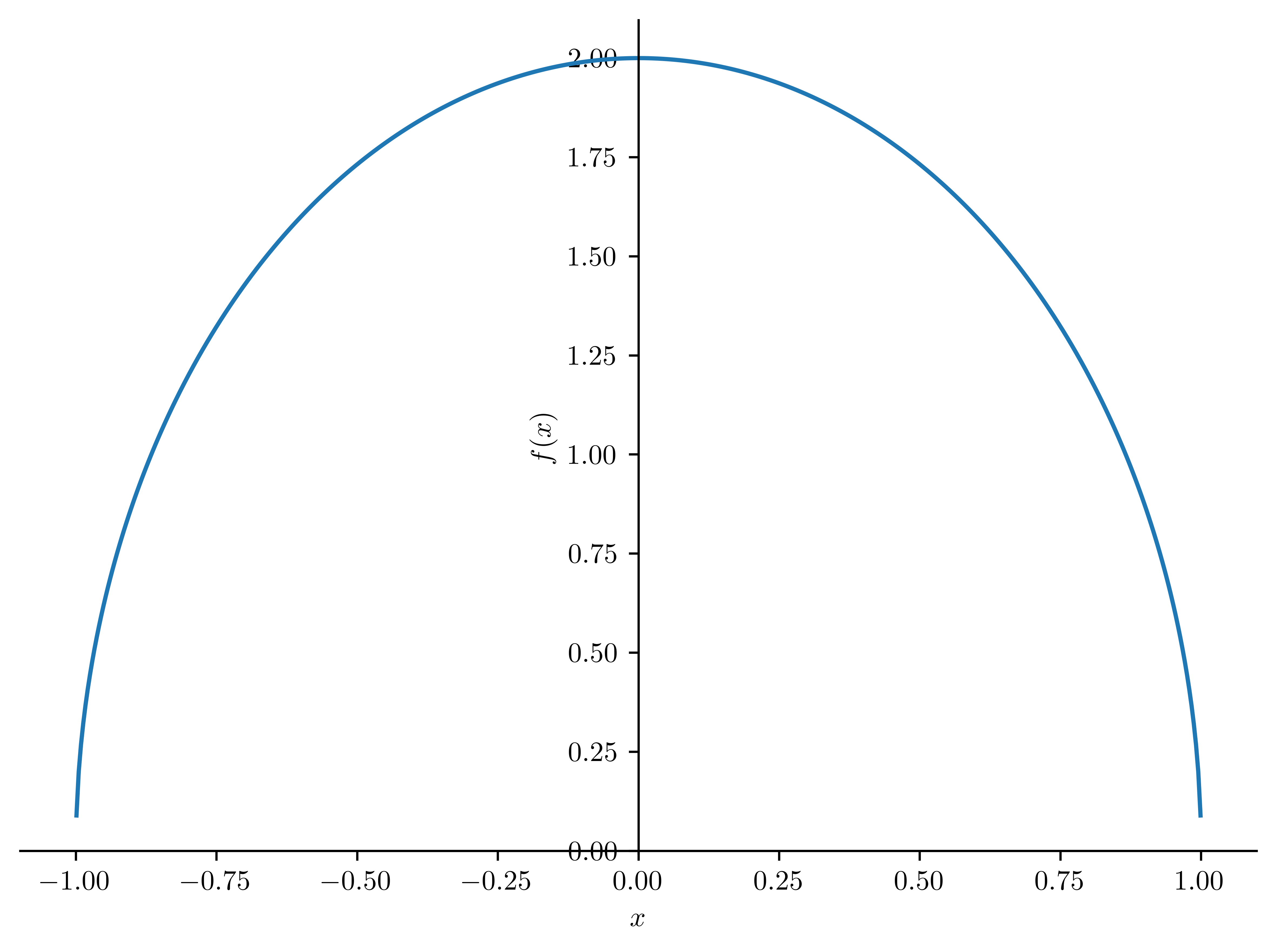
val_sym = sympy.integrate(f, (x, a, b))val_symLoading...
mpmath.mp.dps = 75f_mpmath = sympy.lambdify(x, f, "mpmath")val = mpmath.quad(f_mpmath, (a, b))sympy.sympify(val)Loading...
sympy.N(val_sym, mpmath.mp.dps + 1) - valLoading...
%timeit mpmath.quad(f_mpmath, [a, b])1.64 ms ± 11.7 μs per loop (mean ± std. dev. of 7 runs, 1,000 loops each)
f_numpy = sympy.lambdify(x, f, "numpy")%timeit integrate.quad(f_numpy, a, b)134 μs ± 2.25 μs per loop (mean ± std. dev. of 7 runs, 10,000 loops each)
double and triple integrals
def f2(x, y):
    return np.cos(x) * np.cos(y) * np.exp(-(x**2) - y**2)


def f3(x, y, z):
    return np.cos(x) * np.cos(y) * np.cos(z) * np.exp(-(x**2) - y**2 - z**2)
integrate.dblquad(f2, 0, 1, lambda x: 0, lambda x: 1)Loading...
integrate.tplquad(f3, 0, 1, lambda x: 0, lambda x: 1, lambda x, y: 0, lambda x, y: 1)Loading...
x, y, z = sympy.symbols("x, y, z")f2 = sympy.cos(x) * sympy.cos(y) * sympy.exp(-(x**2) - y**2)f3 = sympy.cos(x) * sympy.cos(y) * sympy.cos(z) * sympy.exp(-(x**2) - y**2 - z**2)sympy.integrate(f3, (x, 0, 1), (y, 0, 1), (z, 0, 1)) # this does not succeedLoading...
f2_numpy = sympy.lambdify((x, y), f2, "numpy")integrate.dblquad(f2_numpy, 0, 1, lambda x: 0, lambda x: 1)Loading...
f3_numpy = sympy.lambdify((x, y, z), f3, "numpy")integrate.tplquad(
f3_numpy, 0, 1, lambda x: 0, lambda x: 1, lambda x, y: 0, lambda x, y: 1
)Loading...
mpmath.mp.dps = 30f2_mpmath = sympy.lambdify((x, y), f2, "mpmath")res = mpmath.quad(f2_mpmath, (0, 1), (0, 1))
resmpf('0.430564794306099099242308990195783')f3_mpmath = sympy.lambdify((x, y, z), f3, "mpmath")res = mpmath.quad(f3_mpmath, (0, 1), (0, 1), (0, 1))sympy.sympify(res)Loading...
%time res = sympy.sympify(mpmath.quad(f3_mpmath, (0, 1), (0, 1), (0, 1)))CPU times: user 47.1 s, sys: 3.37 ms, total: 47.1 s
Wall time: 47.2 s
Line integrals
t, x, y = sympy.symbols("t, x, y")C = sympy.Curve([sympy.cos(t), sympy.sin(t)], (t, 0, 2 * sympy.pi))sympy.line_integrate(1, C, [x, y])Loading...
sympy.line_integrate(x**2 * y**2, C, [x, y])Loading...
Integral transformations
Laplace transforms
s = sympy.symbols("s")a, t = sympy.symbols("a, t", positive=True)f = sympy.sin(a * t)sympy.laplace_transform(f, t, s)Loading...
F = sympy.laplace_transform(f, t, s, noconds=True)FLoading...
sympy.inverse_laplace_transform(F, s, t, noconds=True)Loading...
[sympy.laplace_transform(f, t, s, noconds=True) for f in [t, t**2, t**3, t**4]]Loading...
n = sympy.symbols("n", integer=True, positive=True)sympy.laplace_transform(t**n, t, s, noconds=True)Loading...
sympy.laplace_transform((1 - a * t) * sympy.exp(-a * t), t, s, noconds=True)Loading...
Fourier Transforms
w = sympy.symbols("omega")f = sympy.exp(-a * t**2)F = sympy.fourier_transform(f, t, w)FLoading...
sympy.inverse_fourier_transform(F, w, t)Loading...
sympy.fourier_transform(sympy.cos(t), t, w) # not goodLoading...
- Johansson, R. (2024). Numerical Python: Scientific Computing and Data Science Applications with Numpy, SciPy and Matplotlib. Apress. 10.1007/979-8-8688-0413-7