import matplotlib.pyplot as plt
import numpy as np
import scipy.stats as st
from scipy.optimize import minimize

rng = np.random.default_rng(seed=1)
Task 0
Play around with the jupyter notebook from the lecture and see if you can get better accuracy results.
Solution: My best accuracy was 0.76 with bp, s3 and s5
Task 1: Least-Squares Method Analytically
Given are 10 value pairs for from 1 to 10, where the are Poisson-distributed measurements around expectation values .
The parameter is to be estimated using the weighted least-squares method. To do this, consider the following functions:
1.1
Analytically calculate the estimators as a function of which minimize the corresponding functions. Are there special cases where the estimators are not defined?
1.2
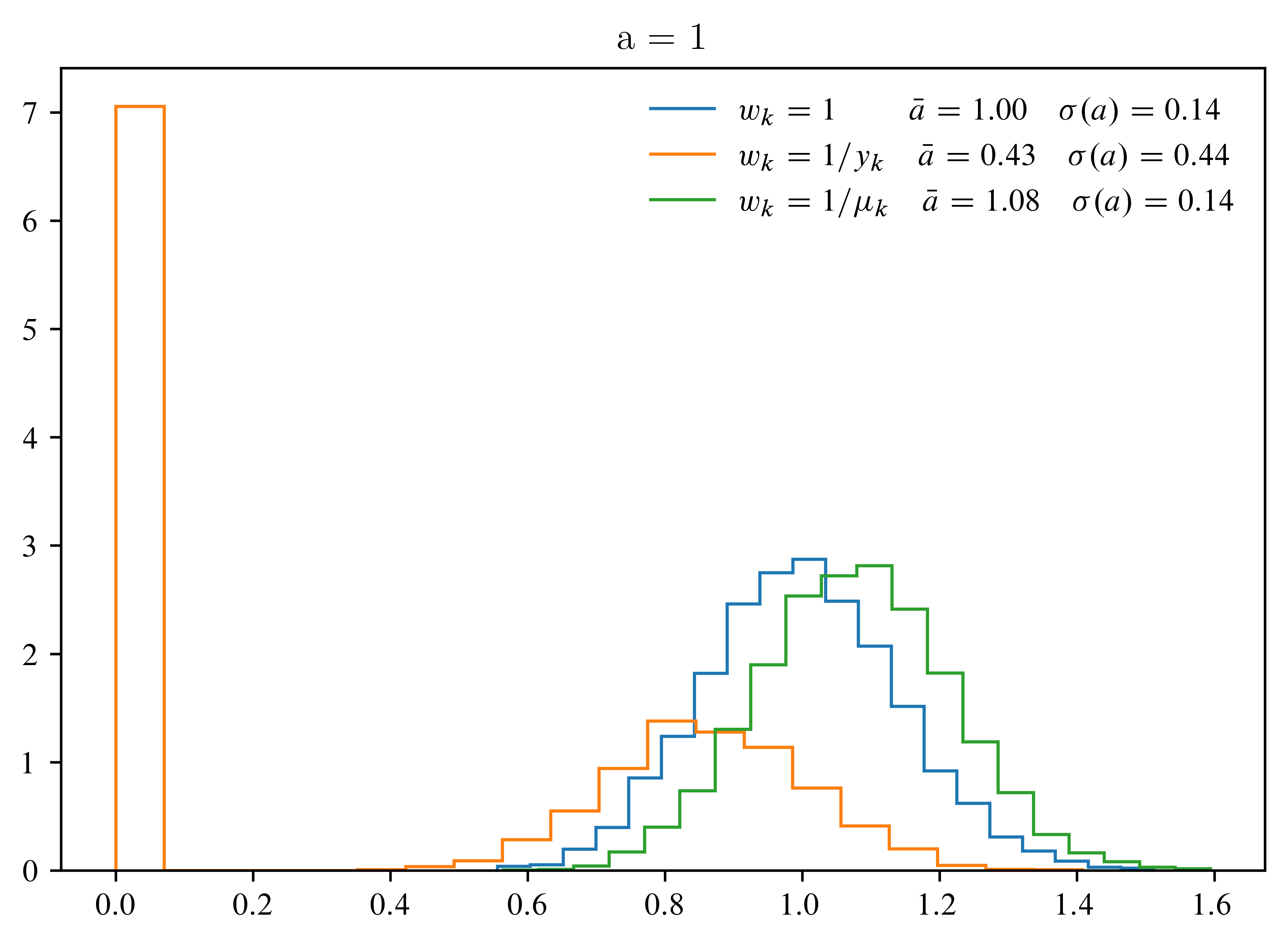
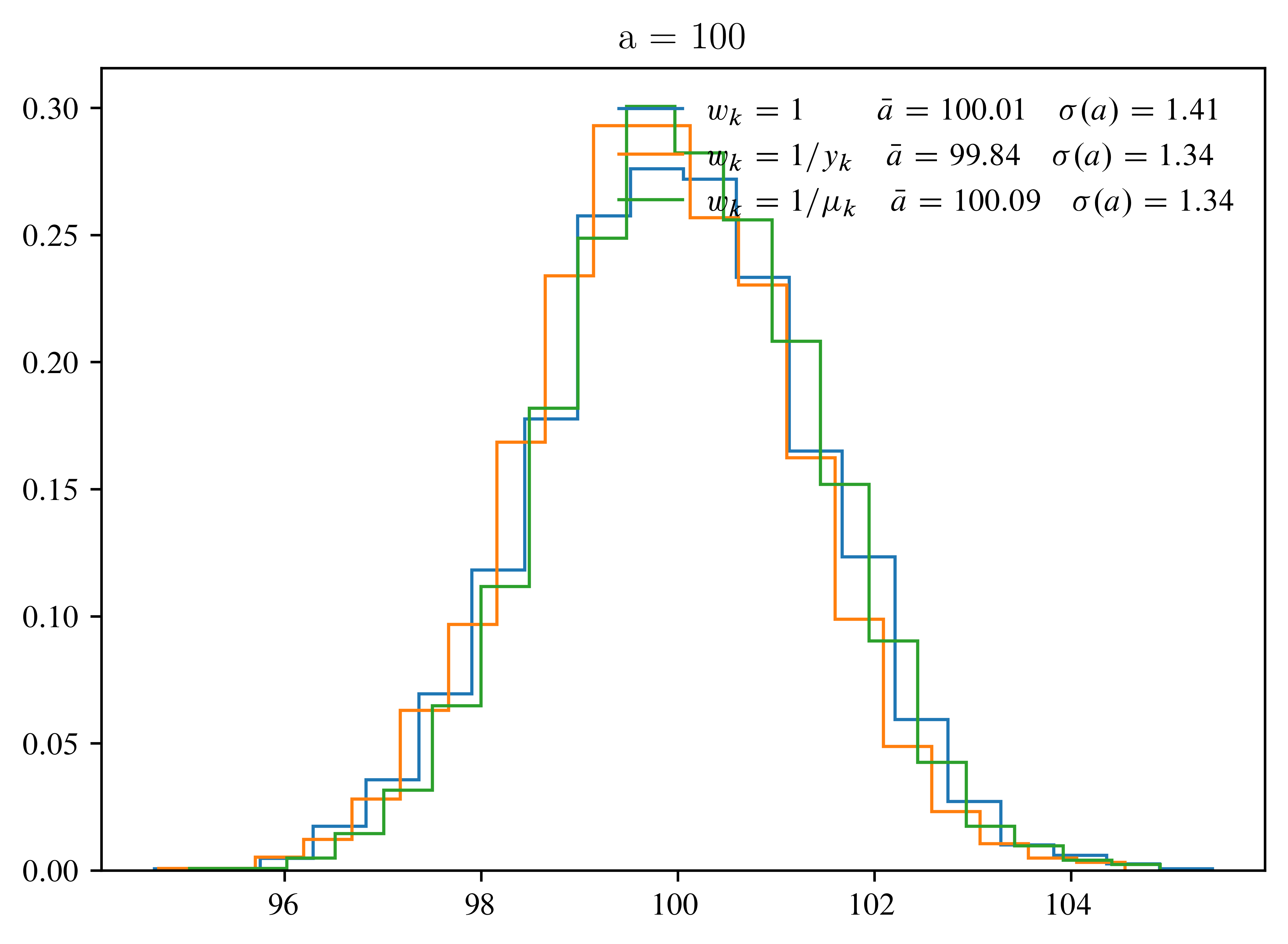
Compute the distributions of the estimators using Monte-Carlo simulation for and . Which estimator has the smallest bias and variance?
def generate(a, n=10, size=5000):
    k = np.arange(1, n + 1)  # Indices of the y_k, so [1,2,...,10]
    y = rng.poisson(
        a * k, size=(size, n)
    )  # draw size times n (=len(ks)) poisson numbers with mean a*k
    return k, y


estimators = {
    # lambda: anonymous functions
    "1\\;\\quad": lambda k, y: np.sum(y * k) / np.sum(k**2),
    # this can go wrong for small a (as y=0)
    "1/y_k": lambda k, y: np.sum(k) / np.sum(k**2 / y),
    # this will go wrong for a = 0
    "1/\\mu_k": lambda k, y: np.sqrt(np.sum(y**2 / k) / np.sum(k)),
}

for a in (1, 100):
    k, y = generate(a)
    plt.figure(figsize=(5.5, 4), layout="constrained")
    for label, estim in estimators.items():
        with np.errstate(divide="ignore"):
            ab = [estim(k, yb) for yb in y]
        ma = np.mean(ab)
        sa = np.std(ab)
        w, xe = np.histogram(ab, bins=20)
        w = w / np.sum(w) / np.diff(xe)
        plt.stairs(
            w,
            xe,
            label=f"$w_k = {label} \\quad \\bar{{a}} = {ma:3.2f} \\quad \\sigma(a) = {sa:.2f}$",
        )
    plt.title(f"a = {a}")
    plt.legend(frameon=False, loc="upper right")