

MOLE Open-Source Ecosystem Organization#
Table of Contents#
Statement of Purpose#
First, it is important to state the purpose and scope of the MOLE OSE organization to provide context for the MOLE OSE structural organization depicted in Figure 1. The MOLE Open-Source Ecosystem organization was established to support the MOLE library’s ecosystem as a sustainable, robust, secure, and more readily available library of high-order mimetic differential operators. The MOLE OSE serves academic and industrial communities that require high-performance solvers for PDEs.
MOLE OSE Organization Pillars#
The MOLE organization is strategically supported by four working pillars;
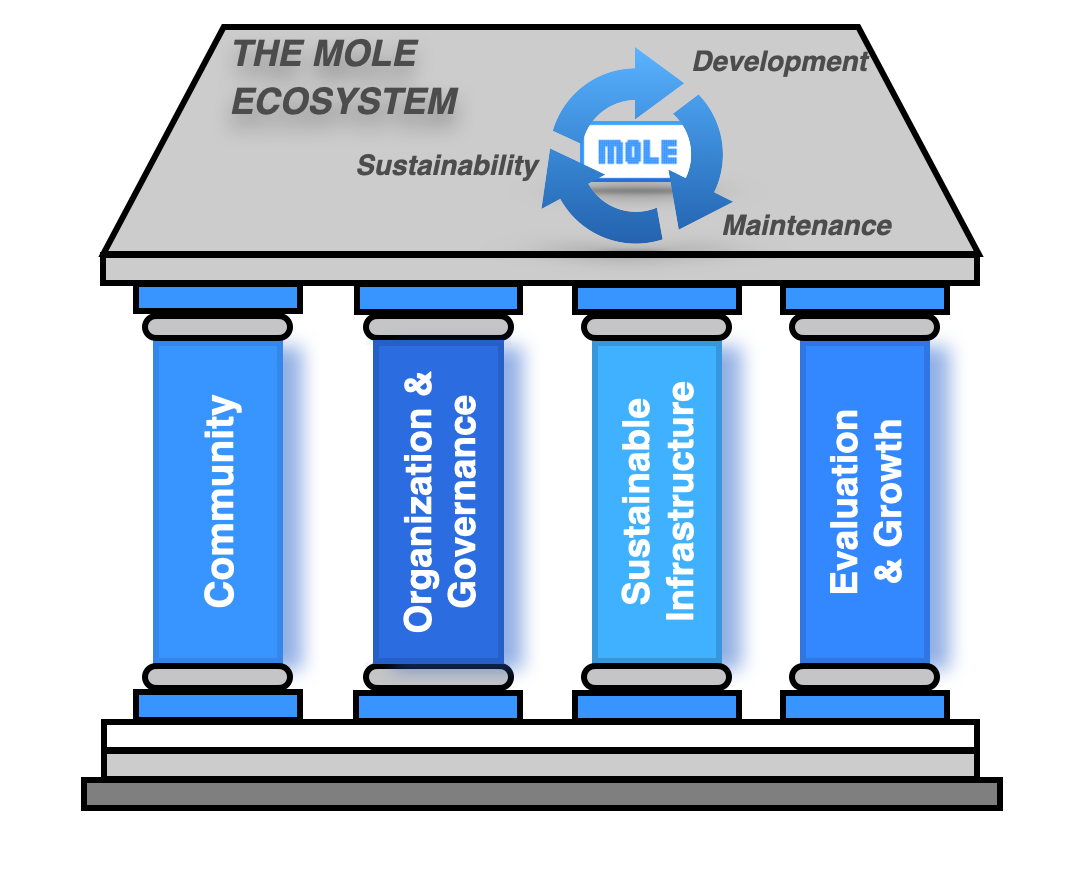 Figure 1. The four pillars of the MOLE Ecosystem Organization.
Community Engagement Pillar#
This pillar hosts all activities and actions related to the management and support of a leadership team of experts in the fields of computational sciences, software engineering, and high-performance computing working cohesively with external collaborators, contributors and users of the MOLE library. Further, the leadership team, collaborators, contributors and users form the MOLE community.
In order to engage and recruit new members, this pillar fosters the organization of the Annual MOLE Users meeting and in person community engagements like national and international workshops, active participation in conferences, and integration of MOLE into courses taught at SDSU. The production of the quarterly newsletters and targetted communications are managed also under this pillar.
Organization and Governance Pillar#
This pillar results from a well-defined governance model, the pillar fosters and promotes work interactions between the leadership team and all the MOLE OSE stakeholders. For instance, the creation and update the Governance and Code of Conduct documents, the prompt resolution of conflicts, the design and implementation of the MOLE OSE strategic plan. Under this pillar, the leadership team ensures that all the pillars and organizational circles are relevant and effective to the MOLE OSE operations.
Sustainable Infrastructure Pillar#
This pillar supports the work of an interdisciplinary, multilocation, and cohesive MOLE community, including hands-on tutorials, documentation, and online tools to promote active and timely communications between members of the MOLE Community.
It adopts agile and distributed open-source development practices, ensuring regular releases, responsive maintenance, and integration of community contributions. The OSE sustainable infrastructure is built on a well-maintained GitHub repository to support active collaborations between contributors and other sustainable OSEs.
Evaluation and Growth Pillar#
This pillar hosts the implementation and management of a set of well-defined metrics and performance indicators that guarantee the sustainability and relevancy of the MOLE library and the OSE organization, their growth, their evolution and the library’s adoption within third-party academic and commercial software projects.
We have established proactive policies for software quality assurance, security audits, and mitigation of technical and governance risks within the MOLE OSE Evaluation and Growth pillar, where we have feedback loops to produce measurable performance indicators of the effectiveness of our 4-pillars OSE.
MOLE OSE Governance Model#
The four MOLE OSE pillars have interconnected and synergetic activities that sustain the MOLE OSE Organization which actively relies on input from the MOLE community. Our governance model has well-defined processes for contributions, library operations and management. Thus, the management of the MOLE organization is led by a steering council, and four governing circles.
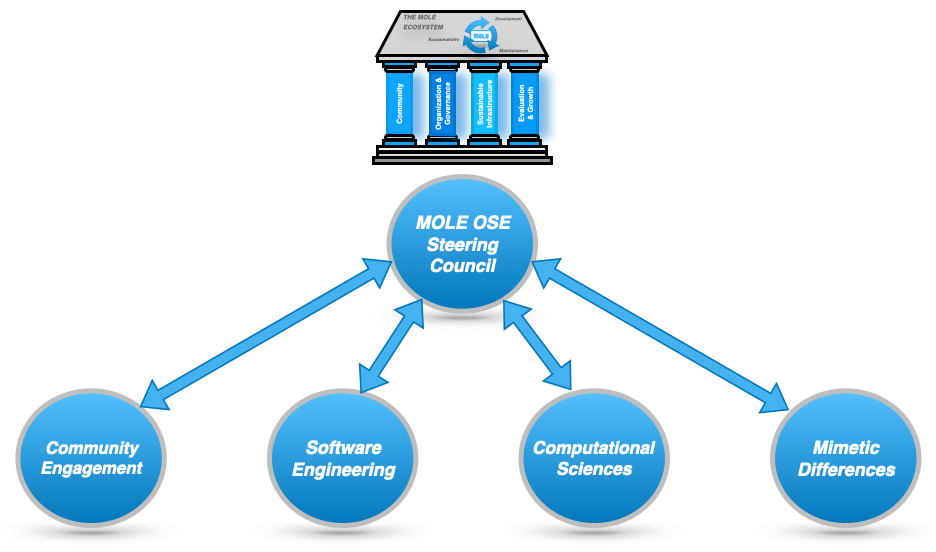 Figure 2. The MOLE OSE governance and leadership is organized in four strategic areas reflecting the domains of expertise and competence of the members in the Leadership team and founders of MOLE library. These domains are; software engineering, computational sciences, mimetic differences, and community engagement.
See the MOLE OSE Governance document for more information on how the steering council or any of the governance circles onboard or offboard their members.
MOLE Steering Council#
The members of council are responsible for facilitating the establishment of community consensus, for stewarding project resources, and in some situations they may need to make project decisions whenever the normal decision-making process fails at reaching consensus by the community. The council members are formed by the leadership team members, chairs from the MOLE governing circles, MOLE founders, and strategic partners who financially support the MOLE OSE.
All council members possess the required expertise in the software engineering and numerical areas relevant to the purpose and scope of the MOLE organization.
MOLE Community Engagement Circle#
The members of this circle oversee some of the activities in the MOLE Community Engagement and MOLE Organization and Governance pillars pertaining to outreach and education events, promotion of the MOLE library functionality, and onboarding of new members to the MOLE community.
The circle is chaired by members of the MOLE Leadership team, and it is open to any member of the MOLE community, as long as they agree to comply with the MOLE OSE Code of Conduct, and there are no objections.
MOLE Software Engineering Circle#
The members of this circle oversee most of the activities in the MOLE OSE Sustainable Infrastructure pillar and some in the MOLE OSE Organization and Governance pillar. This includes: security of computer programs, library design and implementations, MOLE software ecosystem, and ecosystems of MOLE-required software, build systems, documentation systems, test harness, design and implementation of the MOLE APIs in the targeted languages, and compliance up-to-date software engineering standards, MOLE library licensing and periodic MOLE library releases.
Membership of this circle will require demonstrated software engineering competency, in particular within the scope of the MOLE Ecosystem.
MOLE Computational Sciences Circle#
The members of this circle safeguard the relevancy of the MOLE library by fostering strategic collaborations to solve PDE’s using mimetic differences in emerging computational applications and challenges in sciences and engineering. Members of this circle support activities in the MOLE Community Engagement and MOLE OSE Evaluation and Growth pillars. In particular, they produce MiniApps to showcase and demonstrate the applicability of the MOLE library, and also make decisions on library extensions to support needs from the community.
Membership to this circle is extended to anyone who possesses expertise in computational areas where the MOLE library can be used.
MOLE Mimetic Differences Circle#
The members of this circle are responsible for maintaining and advancing the implementation of Mimetic Differences methods (MD) and for promoting and recruiting applications that can benefit from the use of MD as new users of MD, or members from industry and academia who already use MD but are in need of robust, reliable and scalable MD implementations. This circle supports the sustainability of key algorithmic and MOLE library functionalities through activities under the OSE Evaluation and Growth pillar.
Membership to this circle is extended to anyone who possesses expertise in mathematics and scientific computing, in particular in numerical solutions to partial differential equations.
Participants can be removed from any of the governance circles whenever a proposal to do so passes the consensus process as described in the MOLE OSE Governance document.